
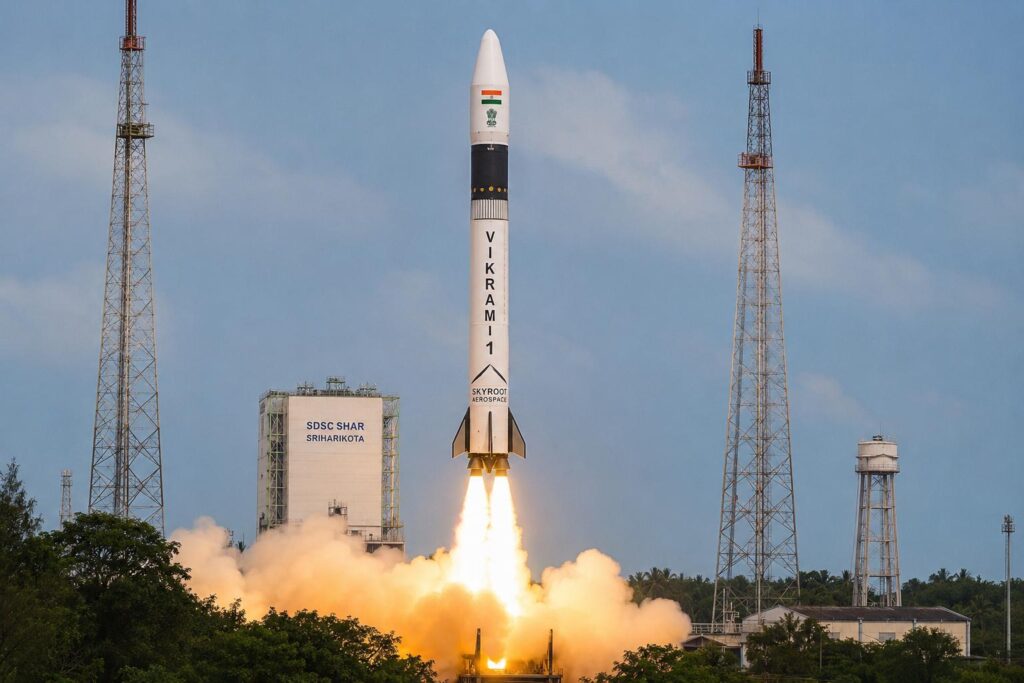
India’s space programme is approaching a critical economic test: can the country convert its scientific achievements into a globally competitive commercial industry?
Union Minister of State for Space Jitendra Singh recently said India’s space economy, currently valued at around $9 billion, could reach $40–45 billion within seven to eight years. Speaking at a Bloomberg New Economy Forum roundtable in New Delhi, he identified private investment, predictable demand, faster regulatory approvals and sustainable business models as essential to achieving the target.
The ambition is substantial. Growing from $9 billion to $40–45 billion in that period would require annual nominal growth of roughly 20–25 per cent. The government has outlined the direction of travel. Still, the decisive question is how much of the projected expansion will come from existing business and how much depends on future investment and demand.
From government programme to private enterprise
For decades, India’s space programme was dominated by the Indian Space Research Organisation (ISRO), with private companies largely serving as suppliers and contractors. The 2020 reforms and Indian Space Policy 2023 opened more opportunities for private firms to develop launch vehicles, manufacture satellites and provide space-based services.
The results are visible in the growth of the start-up ecosystem. A government factsheet published in August 2026 put the number of registered space start-ups at around 440, compared with one in 2014. Private investment had risen from $100.5 million in 2021–22 to $618.5 million by March 31, 2026.
The Indian National Space Promotion and Authorisation Centre (IN-SPACe) facilitates private-sector participation, while NewSpace India Limited (NSIL), ISRO’s commercial arm, supports the commercialisation of space technologies and services.
Yet a growing number of start-ups and higher investment do not automatically translate into a larger, profitable industry. The test is whether these companies can win contracts, deliver products reliably and generate recurring revenue.
Satellite services offer the biggest opportunity
The commercial potential extends well beyond launching rockets. Satellite communications, Earth observation and geospatial data can serve telecommunications, agriculture, infrastructure, disaster management and urban planning.
Earth observation is particularly promising. Satellite imagery and data analytics can help monitor crops, map land use, assess environmental changes and track infrastructure projects. The value increasingly lies in converting raw data into useful information for customers rather than merely selling images.
A significant initiative is a proposed 12-satellite Earth-observation constellation involving a consortium led by PixxelSpace India, alongside Dhruva Space, PierSight Space and SatSure Analytics India. The project carries an investment commitment of around ₹1,200 crore and is expected to become operational by 2029.
The project could create opportunities across satellite manufacturing, launch services, ground infrastructure and data applications. However, the investment commitment is not evidence of revenue already earned. Its commercial success will depend on completing the constellation, securing customers and selling services at competitive prices.
Satellite communications also offer scope for growth, particularly in remote areas, maritime operations and aviation. But providers must navigate spectrum allocation, regulatory requirements, infrastructure costs and competition from terrestrial broadband networks.
Launch services: an established strength
India has developed considerable expertise in satellite launches and has served international customers. A January 2026 parliamentary reply reported that ISRO had launched 434 foreign satellites, including 399 after 2014. These launches had earned India approximately €323 million and $233 million.
The figures demonstrate that international launch services already generate revenue. But cumulative earnings from foreign satellite launches should not be confused with annual revenue or the value of future contracts.
Private companies are also developing launch vehicles and satellite platforms. Industrial participation in launch-vehicle manufacturing could expand production capacity and create opportunities for Indian suppliers.
The challenge is to compete internationally on reliability, cost and delivery schedules. Launch services are capital-intensive, and development delays or technical failures can undermine a company’s finances. India’s existing capabilities provide a foundation, but expanding its share of the global market will require consistent performance and repeat business.
Can public funding generate private revenue?
The government has introduced financial support to help space businesses move from research and prototypes to commercial deployment. Measures include a ₹1,000 crore venture capital fund and a ₹500 crore Technology Adoption Fund, along with seed funding, access to ISRO facilities, and technology transfers.
Such support can help companies meet the high initial costs of developing satellites, propulsion systems and other specialised technologies. Government agencies can also provide early demand by purchasing services and supporting proof-of-concept projects.
But public funding cannot substitute indefinitely for a commercial market. Businesses must attract customers beyond initial pilot projects and government contracts. They also need sufficient revenue to cover operating costs, invest in new technology and compete for international orders.
Predictable demand is therefore central to the growth strategy. Without it, promising companies may struggle to move from technology demonstrations to large-scale production.
Exports will be crucial
India’s cost competitiveness and engineering expertise could help its companies enter international supply chains in satellite manufacturing, launch services, communications and data analytics. Partnerships with foreign companies may provide access to technology, investment and overseas customers.
However, announced collaborations and memorandums of understanding are not equivalent to executed contracts. Export growth must ultimately be measured through actual sales, delivered services and payments received.
The scale of the target makes this distinction important. India’s space economy was estimated at $8.4 billion in 2023, representing about 2% of the global market. The government’s longer-term strategy projects growth to approximately $44 billion by 2033 and $100 billion by 2040.
The government has also said that an assessment of the sector’s current economic size is being undertaken with the Ministry of Statistics and Programme Implementation. Updated and comparable figures will be necessary to judge progress accurately.
The real test is commercial viability
India has established the scientific capabilities and policy framework needed to expand its space industry. The growth of private investment and start-ups indicates that the sector is moving beyond its traditional government-led structure.
But the $40–45 billion projection remains a target, not a guaranteed outcome. Achieving it will depend on scaling satellite services, expanding launch capacity, attracting international customers and turning investment commitments into sustained commercial activity.
The government must also provide transparent data on industry revenue, exports, executed contracts and recurring income. Without these measures, the number of start-ups and the volume of investment offer only a partial picture of progress.
India’s next space challenge is not simply to build more satellites or launch more rockets. It is to build businesses that can sell their technology, retain customers and compete globally. The success of the $45 billion ambition will ultimately be measured by commercial revenue, not announcements alone.