
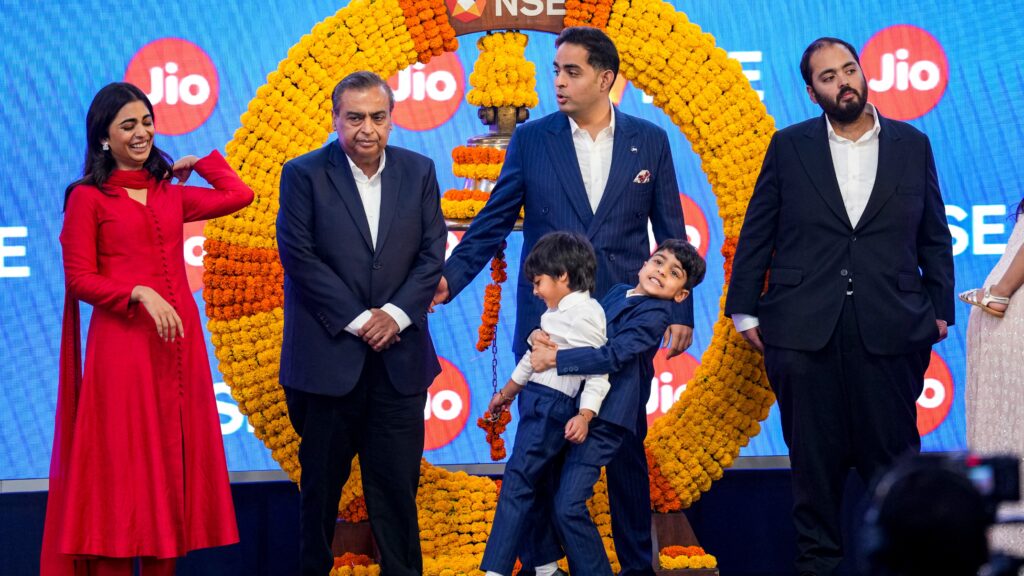
Jio Platforms has won the stock market’s approval. Now comes the harder test: delivering the growth that investors have already begun pricing into its shares.
The company’s market debut on October 28, 2026, was emphatic. Jio raised ₹30,213 crore through its initial public offering (IPO), with shares priced at ₹1,119. The stock closed its first trading session at ₹1,417.50, nearly 27 per cent above the issue price, valuing the company at approximately $137 billion. The shares extended their gains on 29 October, according to Reuters.
The listing marked a milestone for Reliance Industries chairman Mukesh Ambani, whose strategy has transformed Jio from a disruptive mobile operator into a much broader digital-services business. But the market’s enthusiasm also raises the stakes. Jio must now show that its earnings can sustain the expectations behind its valuation.
The central challenge is shifting from acquiring customers to extracting greater value from them.
A profitable business under greater scrutiny
Jio enters its post-IPO phase with substantial financial strength. For FY2025–26, Jio Platforms reported revenue of ₹1,46,885 crore, up 14.6 per cent year on year. EBITDA rose 18.8 per cent to ₹76,255 crore, while profit after tax increased 15.1 per cent to more than ₹30,000 crore. Its EBITDA margin improved to 51.9 per cent, according to Reliance Industries’ financial disclosures.
These figures establish that Jio is not merely selling investors a promise of future technological growth. It has a large, profitable business capable of generating substantial operating earnings.
However, a successful listing does not automatically make the shares an attractive investment at every price. As a separately listed company, Jio will face greater scrutiny of its earnings, capital expenditure, cash flows and management decisions. If growth falls short of market expectations, the stock could weaken even if the business continues to expand.
That is the first post-IPO test: sustaining operating performance while meeting the higher expectations created by the listing.
The tariff question
One of the most immediate opportunities lies in mobile tariffs. Jio’s customer base exceeded 524 million at the end of March 2026, while its 5G subscriber base crossed 268 million. Its network carried 241 exabytes of data during FY26, up 30.8 per cent year on year.
The scale is extraordinary, but monetisation remains crucial. Average revenue per user, or ARPU, measures the monthly revenue generated per subscriber. Increasing it can improve earnings without requiring customer numbers to grow at the same rate.
Brokerages covering the IPO have identified a potential tariff increase of around 12–15 per cent as a possible growth driver, although the timing and size remain forecasts rather than confirmed company decisions. Elara Capital has projected that Jio’s ARPU could rise from ₹214 in FY26 to ₹257 in FY29.
Higher tariffs could strengthen revenue, but the strategy carries risks. Indian consumers remain price-sensitive, and aggressive price increases could compromise affordability or prompt some customers to reduce spending. Jio must balance higher revenue per user against customer retention and competition from Bharti Airtel and Vodafone Idea.
Broadband: the second growth engine
Jio’s next major opportunity is home broadband. The company reported that JioAirFiber had connected 13 million homes by the end of FY26. Its wireless broadband technology allows it to serve households in areas where installing conventional fibre may be difficult or expensive.
Broadband can also create opportunities to sell bundled entertainment and other digital services. A household buying several services could generate more revenue than a customer using only mobile connectivity.
But expansion must be profitable. Customer acquisition, equipment, installation and network capacity all carry costs. The important measure will not simply be how many homes Jio connects, but how quickly those connections generate enough recurring revenue to justify the investment.
The broadband opportunity is substantial, but its financial contribution must be demonstrated through subscriber growth, ARPU and margins.
Can digital services become a serious profit centre?
Jio’s longer-term ambition is to move beyond connectivity into enterprise technology, cloud computing, connected devices and artificial intelligence.
This is potentially the most important part of the investment story because digital services could diversify revenue and reduce dependence on mobile tariffs. Yet the segment remains much smaller than Jio’s core connectivity business.
An analysis published by NDTV Profit, citing Elara Securities, estimated that digital services would contribute around 12 per cent of revenue and 5 per cent of EBITDA in FY27. Elara projected that the segment’s revenue could double and its EBITDA triple by FY30. These are brokerage forecasts, not guaranteed outcomes.
AI offers opportunities in consumer applications and business services, but it also demands investment in computing infrastructure, data centres, software and skilled personnel. Jio will need to show that customers are willing to pay for these services and that the resulting revenue produces attractive margins.
For investors, the evidence will be actual contracts, adoption, revenue growth and cash generation, rather than announcements alone.
IPO money and the debt question
The IPO has also created an opportunity to strengthen Jio’s financial position.
According to the offer disclosures, approximately ₹27,500 crore of the proceeds is earmarked for repayment or prepayment of borrowings at Reliance Jio Infocomm, Jio’s principal telecom subsidiary. Its net debt stood at ₹27,579 crore at the end of March 2026, down from ₹45,273 crore a year earlier.
Debt reduction could lower financing costs and provide greater flexibility for future investment. But Jio must continue spending on spectrum, network capacity, broadband and technology to remain competitive.
The challenge is to improve returns on capital while maintaining investment in future growth. A strong balance sheet will help, but only sustained cash generation can establish whether the company’s expansion is financially self-supporting.
What happens after the market celebration?
The listing also brings Jio under more direct public-market scrutiny. Investors will expect transparent reporting, disciplined capital allocation and clear evidence that the business is meeting its targets.
The key indicators to watch are ARPU growth, subscriber retention, broadband additions, digital-services profitability, debt reduction and cash generation after capital expenditure.
These measures will reveal more about Jio’s long-term prospects than short-term movements in its share price.
Jio has already demonstrated that it can build scale and generate substantial earnings. Its next task is to prove that it can turn those advantages into sustained growth while meeting the expectations created by its valuation.