France has stepped up security after a second weekend of nationwide demonstrations over rising living costs, deteriorating public services and economic inequality, as President Emmanuel Macron’s government faces mounting pressure to contain unrest without deepening public anger.
The French Interior Ministry said 410,000 people participated in demonstrations across the country on October 24, including 110,000 in Paris. Trade unions put the nationwide turnout at approximately 800,000. The government counted 289 public demonstrations, compared with 441 the previous week, when 550,000 people took part, according to official figures.
Authorities deployed 70,000 police officers and gendarmes, 10,000 more than during the previous weekend’s protests. By 7.30 am on Sunday, the Interior Ministry had recorded 1,314 arrests, 53 security personnel injured, 75 firefighting interventions and 24 shops looted. The figures were provisional. The previous Saturday, authorities had reported 2,628 arrests and 1,522 shops affected by damage or looting.
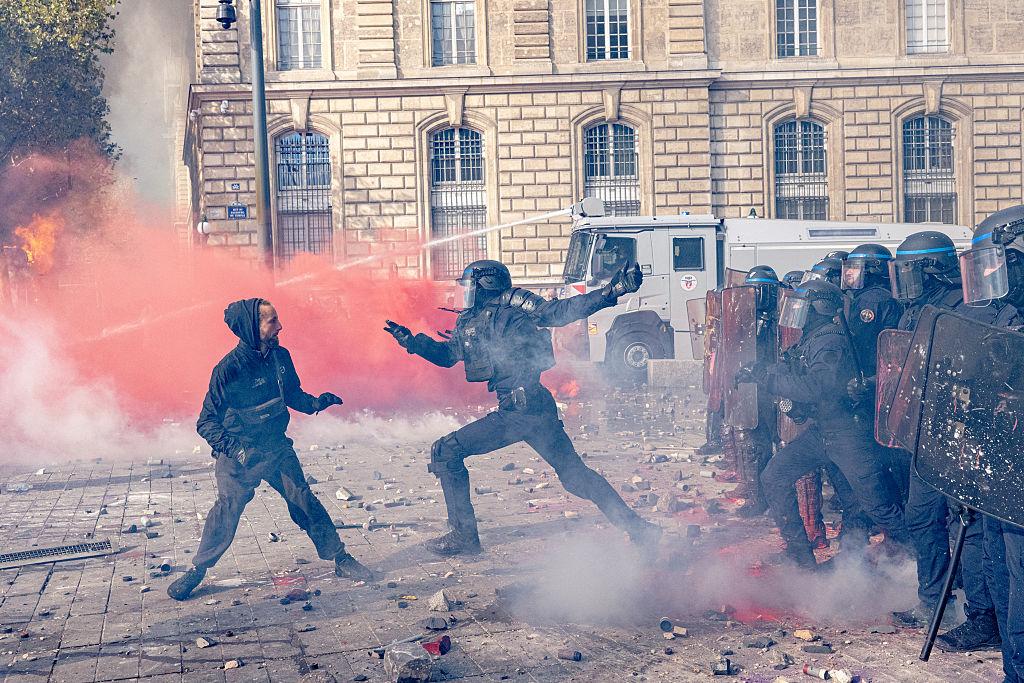
Although most organised marches proceeded peacefully, clashes broke out in several cities after demonstrations ended. Police used tear gas and water cannon in parts of Paris and Marseille, while confrontations were also reported in Lyon, Bordeaux, Grenoble, Lille and other cities. Authorities attributed much of the violence to groups operating alongside or outside the main demonstrations.
Economic grievances widen the protests
The demonstrations have grown beyond their initial focus on school conditions and teacher shortages in working-class suburbs. Students have been joined by trade unionists and other groups demanding better wages, affordable living conditions and protection of public services.
Protesters have also raised concerns about inequality and government spending priorities. The unrest reflects several overlapping grievances rather than a single dispute over prices.
The distinction matters for the government. A response focused exclusively on public order may contain immediate violence but is unlikely, by itself, to address demands relating to household purchasing power, education and public services.
The latest demonstrations were less violent overall than those of October 17, according to the Interior Ministry. However, the continuing mobilisation indicates that the unrest has not been resolved. Protest organisers and trade unions have called for further demonstrations on October 31 and a nationwide strike on November 5, Reuters reported on October 25.
Macron faces political and fiscal constraints
The protests present a challenge for Macron’s government as it attempts to maintain public order while responding to demands for economic relief and better-funded services.
The administration also faces constraints on its room for manoeuvre. Public finances are under pressure, and the government must balance demands for additional spending against efforts to control the budget deficit. Negotiations with unions and student representatives have so far failed to satisfy protesters, according to Reuters.
The government has blamed violent incidents on radical groups and criminal elements, while protest organisers have emphasised the broader social and economic grievances driving participation. The two issues are related but distinct: violence and looting require a law-enforcement response, while the underlying economic and public-service complaints require political and policy decisions.
A wider European concern
France is not alone in facing demonstrations over living costs and public services. Protests were also reported over the weekend in Albania, Italy, Spain and Portugal, although the immediate demands differed between countries. Housing affordability featured prominently in Portugal, while pension protections were among the issues raised in Spain. The demonstrations do not constitute a single coordinated European movement.
For France, the immediate test is whether the government can prevent another escalation while addressing demands that have broadened beyond the original student protests.
The next round of demonstrations, followed by the planned nationwide strike on November 5, will provide a further indication of whether the mobilisation is losing momentum or expanding into a more sustained confrontation over economic policy and governance.