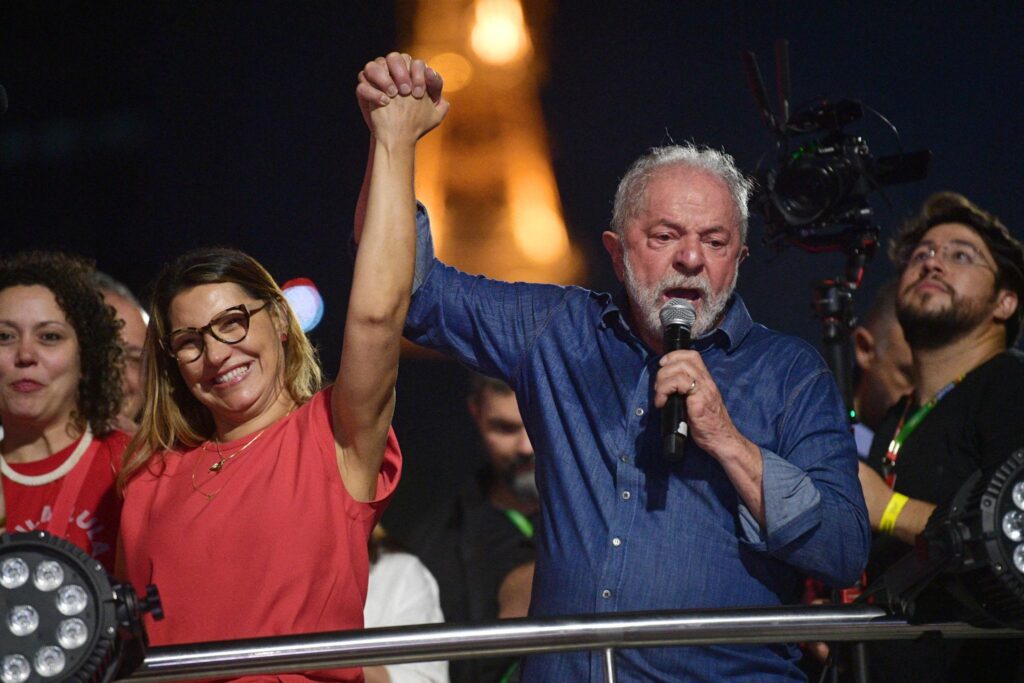
Brazilian President Luiz Inacio Lula da Silva has won a fourth, non-consecutive presidential term, defeating right-wing challenger Flávio Bolsonaro with 51.79 per cent of valid votes against 48.21 per cent, according to Brazil’s Superior Electoral Court. The result gives the 80-year-old Workers’ Party leader another four years in office and keeps Latin America’s largest economy under a government committed to strategic autonomy and a more multipolar world order.
Lula secured approximately 64.26 million votes, defeating the eldest son of former president Jair Bolsonaro by around 4.43 million votes. The outcome, declared on Sunday, October 25, followed a first round in which the challenger had finished ahead.
The Associated Press reported that the election unfolded amid deep political divisions and concerns about the cost of living and public security. Reuters highlighted the significance of Lula’s return for a region where right-wing candidates have recently made electoral gains.
The implications extend well beyond Brazil. Lula’s re-election preserves a government that has sought closer economic engagement with China, a stronger role for BRICS and greater influence for developing countries in international institutions. It also complicates the regional strategy of US President Donald Trump, whose administration has cultivated relations with conservative leaders in Latin America.
But the result does not give Lula an unrestricted mandate. A conservative Congress, fiscal pressures and the need to maintain access to international markets will constrain his ability to translate diplomatic ambitions into policy.
Setback for Trump
Lula’s victory represents a setback for the right-wing political camp associated with Trump. Flávio Bolsonaro had advocated closer alignment with the US president, while Lula has argued that Brazil should preserve its independence in international affairs.
The distinction matters as Washington and Beijing compete for influence through trade, investment, technology, energy and access to strategic resources. Brazil possesses substantial agricultural and mineral wealth, major offshore oil reserves and the Amazon rainforest, giving its government considerable diplomatic leverage.
Trump’s reaction could shape the next phase of bilateral relations. Reuters reported that he questioned the Brazilian election, describing it as appearing to be rigged, without presenting evidence to substantiate the allegation.
Any escalation could complicate relations between Washington and Brasília, particularly over trade and investment. However, Lula has little incentive to turn the relationship into a confrontation. The United States remains an important economic partner, and Brazil needs foreign investment and access to major markets.
The likely calculation in Brasília is to resist political pressure from Washington while keeping channels of economic and diplomatic engagement open. Strategic autonomy, in Lula’s formulation, means maintaining the freedom to work with different powers rather than choosing one camp.
China and BRICS gain continuity
China is likely to remain central to Brazil’s economic diplomacy. It is
Brazil’s largest trading partner, buying agricultural commodities, iron
ore and other resources while investing in sectors including
electricity, infrastructure and manufacturing.
Lula has sought to deepen this relationship while promoting a
multipolar international order in which emerging economies have
greater influence. His re-election provides continuity for that
approach and reinforces Brazil’s commitment to BRICS, the grouping
that includes Brazil, Russia, India, China and South Africa, alongside
additional members.
For Beijing, Lula’s return offers a more predictable diplomatic
partner on questions of global governance and economic
cooperation. But Brazil’s relationship with China is principally driven
by national interests, not an unconditional strategic alignment.
Nor is BRICS a unified geopolitical bloc. Its members have different
security priorities and economic relationships with the West. India,
for instance, participates in BRICS while maintaining a strategic
partnership with the United States.
Lula’s victory may strengthen calls for reform of international
financial institutions and greater representation for developing
countries. It does not guarantee agreement among BRICS members
on how those reforms should be pursued.
For India, the result offers continuity with an important partner in
the G20 and BRICS. New Delhi and Brasília share interests in
reforming global governance and expanding the voice of developing
economies, although disagreements over trade and market access
remain possible.
The Amazon’s global significance
Climate policy is another area where Lula’s re-election could have international consequences.
His administration has prioritised reducing deforestation and protecting the Amazon, whose forests influence regional rainfall, biodiversity and the global carbon cycle. International cooperation on forest conservation and climate finance is likely to remain a feature of Brazil’s diplomacy.
Lula has argued that wealthy countries should contribute more towards protecting forests in developing economies. That position could strengthen cooperation with European governments and other climate-finance partners.
Yet Brazil faces competing pressures. Lula has also supported the development of offshore oil resources near the mouth of the Amazon, exposing tensions between environmental commitments and the pursuit of energy revenues.
His next term will have to reconcile these priorities while dealing with domestic industries and legislators who favour resource extraction. The outcome will matter not only for Brazil but also for international climate negotiations.
A narrow victory, a difficult mandate
Lula’s foreign policy ambitions will depend heavily on his domestic political position. Reuters has highlighted the strength of conservative forces in the incoming Congress, which could complicate legislation on budgets, taxation and economic reform.
The president must also contend with concerns over public debt, interest rates, household finances and economic growth. These pressures limit the resources available for social programmes and infrastructure investment, both important to his domestic agenda.
They also affect Brazil’s international standing. Diplomatic influence depends not only on presidential declarations but on economic performance, institutional stability and the capacity to sustain long-term commitments.
The close election result further underlines the depth of Brazil’s political polarisation. Lula has won another mandate, but nearly half the valid vote went to his opponent. Governing will require more than mobilising his core supporters.
For Washington, the election is a reminder that ideological alignment cannot be assumed across Latin America. For Beijing, it offers continuity in a valuable economic relationship. For India, it preserves a partner in efforts to reform global institutions.
Lula’s fourth term is therefore a victory for continuity in Brazil’s independent foreign policy, not a decisive geopolitical realignment. His government will seek room to manoeuvre between major powers, but its success will depend on balancing international ambitions with domestic constraints.
The central question is whether Lula can turn Brazil’s diplomatic independence into lasting influence without alienating its major trading partners or losing the political support needed to govern at home.