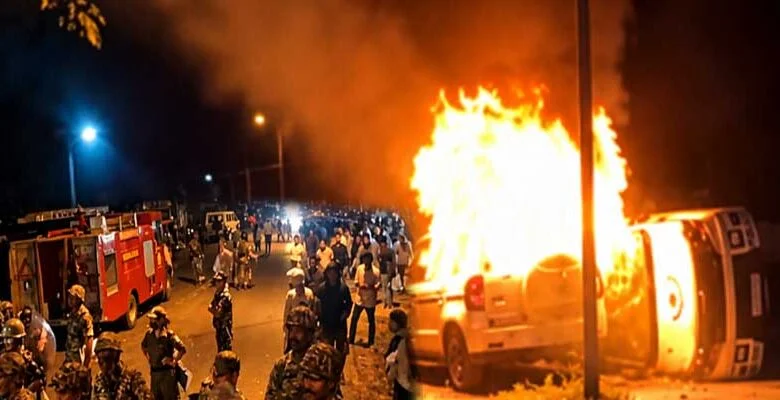
Hundreds of additional security personnel have been deployed in Arunachal Pradesh following violent protests against the proposed 11,200-megawatt Siang Upper Multipurpose Project (SUMP), as the arrest of 26 people and fresh clashes over another dam project have widened the confrontation between the government and indigenous communities.
Reuters reported that the security reinforcement followed clashes in the Siang Valley last week, when protesters allegedly set fire to a police station and an office of the state-owned National Hydroelectric Power Corporation (NHPC). Arunachal Pradesh police chief SD Singh Jamwal told the agency: “Forces are being increased in the places where it is required. We do not want any law and order problem.”
The unrest has also spread beyond the Siang basin. The Times of India reported on Tuesday that a 12-hour bandh in Upper Subansiri district turned violent on Monday, with protesters damaging NHPC equipment, a company vehicle and two police vehicles in Daporijo. Two security personnel were injured and taken for treatment. The agitation was directed against the proposed Menga dam, part of the 1,605-MW Subansiri Upper Hydroelectric Project.
The developments underline the growing challenge facing the Arunachal Pradesh government as opposition to major hydropower projects increasingly centres on ancestral land, indigenous rights, environmental risks and the use of security forces to facilitate preliminary surveys.
Arrests follow Pasighat violence
The latest arrests stem from violence in Pasighat, in East Siang district, on the night of October 23 and into the early hours of October 24. The clashes followed a 12-hour bandh called by organisations opposing the Siang project.
According to a PTI report published by Rediff on Tuesday, 26 people, including five juveniles, were apprehended in connection with the violence. Police said eight criminal cases had been registered and six people detained for questioning. Anti-dam activists Ebo Mili and youth leader Otul Jerang surrendered to the police. The cases include alleged unlawful assembly, rioting, obstruction of public servants and damage to public property.
The violence followed confrontations between security personnel and protesters in the Geku area of Upper Siang district, where tear gas was used to disperse demonstrators demanding the withdrawal of security forces and an end to project-related surveys.
In Pasighat, protesters allegedly set fire to an NHPC office and a police station, damaged vehicles and vandalised the residences of political leaders, including Arunachal Pradesh BJP president Kaling Moyong and legislator Ninong Ering. Police reported injuries to personnel during stone-pelting.
The East Siang district administration imposed restrictions on public gatherings and processions in Pasighat, Mebo and Ruksin. District authorities have said the situation was under control following the violence, although security measures remained in place.
An indigenous land dispute with strategic implications
The proposed SUMP is intended to generate power and regulate water flows in the Siang basin. Its strategic importance has increased following China’s plans for a massive hydropower project on the Yarlung Zangbo river in Tibet, upstream of the Indian border. The river enters Arunachal Pradesh as the Siang and flows into Assam as part of the Brahmaputra river system. New Delhi is concerned about the potential implications of China’s control over a major upstream water source, including the possibility of sudden changes in water flows.
The Indian project, however, faces sustained opposition from sections of the Adi community, whose ancestral lands lie in the proposed reservoir area. Gegong Jijong of the Siang Indigenous Farmers’ Forum told Reuters that opposition would continue until the project was cancelled. “If it is constructed, 27 of our ancestral villages will be completely submerged. At least 40 or 50 more will be affected,” he said.
For residents, the dispute is not confined to electricity generation or national security. It concerns the possible displacement of communities, the loss of farmland and customary land rights, and the disruption of cultural ties to the river and surrounding landscape.
The proposed project is still at the preliminary assessment stage. The government has maintained that current activities are intended to prepare a pre-feasibility report to establish whether the project is viable, rather than signal final approval for construction. Protesters, however, argue that they do not want the project to proceed and have demanded an immediate halt to surveys.
Government offers dialogue, but mistrust persists
Chief Minister Pema Khandu has expressed concern over the violence and offered to hold discussions with community representatives. The government has argued that apprehensions about the project need to be addressed through accurate information, transparency and dialogue.
In an October 26 report, The Indian Express quoted Khandu as saying that “misinformation and misconceptions” about SUMP were creating apprehensions among residents and that the information gap needed to be bridged through “facts, transparency and open dialogue”.
The government's challenge is complicated by the protesters' demands for the release of detained activists, the withdrawal of central security forces and the suspension of pre-feasibility surveys. The latest unrest in the Subansiri valley suggests that opposition to large hydropower projects is not confined to one river basin.
The Siang project sits at the intersection of India's energy ambitions, strategic concerns over China and the rights of indigenous communities. But the growing reliance on security deployments, arrests and restrictions risks deepening mistrust unless residents believe their concerns can influence the decision-making process.
The immediate priority is to prevent further violence. The longer-term test is whether the government can establish a credible process of consultation before advancing a project that could fundamentally alter the landscape and lives of communities along the Siang.