India’s decision to invite Pakistan’s National Heritage and Culture Minister, Aurangzeb Khan Khichi, to an upcoming Shanghai Cooperation Organisation (SCO) forum in New Delhi presents an intriguing diplomatic contrast. Relations between the two countries remain deeply strained following the military confrontation of May 2025. Yet, less than 18 months after Operation Sindoor, India is preparing to host a multilateral gathering to which Pakistan, too, has been invited.
The invitation is significant, but its implications must be assessed carefully. It is neither evidence of a diplomatic breakthrough nor an indication that New Delhi is reconsidering its position on cross-border terrorism. Rather, it illustrates the difficult balance India must maintain between its security concerns and its participation in a regional organisation that includes Pakistan, China, Russia and several Central Asian states.
According to The Indian Express, India has invited Khichi to the inaugural SCO Civilisational Dialogue Forum, scheduled to be held in New Delhi from November 20 to 22. The invitation is part of India’s commitment to hosting the multilateral initiative, which is intended to promote cultural engagement and showcase the heritage, literature, art and traditions of member countries.
The newspaper reported that the invitation was extended as part of India’s obligation to invite representatives from all SCO member states. Hindustan Times likewise reported that all 10 members had been invited and that officials regarded the initiative as a multilateral exercise rather than a bilateral engagement with Pakistan.
The distinction matters. India is not inviting Pakistan to negotiate the future of bilateral relations; it is inviting a member state to participate in an SCO initiative.
The shadow of Operation Sindoor
The invitation comes against the backdrop of one of the sharpest downturns in India-Pakistan relations in recent years.
The April 22, 2025, terrorist attack in Pahalgam, Jammu and Kashmir, killed 26 people. India launched Operation Sindoor on May 7, targeting what it described as terrorist infrastructure in Pakistan and Pakistan-occupied Kashmir. Pakistan retaliated, leading to several days of military exchanges before a ceasefire was announced on May 10.
The confrontation was followed by reciprocal restrictions affecting diplomatic engagement, trade and travel. The Indus Waters Treaty was placed in abeyance by India, while Pakistan suspended bilateral trade and closed its airspace to Indian aircraft.
Against this background, a Pakistani ministerial visit to India would carry symbolic weight. The last visit by a Pakistani foreign minister to India was Bilawal Bhutto-Zardari’s trip to Goa in May 2023 for an SCO foreign ministers’ meeting.
But symbolism should not be mistaken for substance. The proposed visit concerns a cultural forum, not a bilateral dialogue on terrorism, Kashmir, trade or the Indus waters dispute. There is no confirmed indication that the invitation will lead to discussions on these contentious issues.
Indeed, India’s position on terrorism remains central to its diplomatic engagement with Pakistan. At the SCO Council of Heads of Government meeting in Dushanbe on October 20, Defence Minister Rajnath Singh called for collective action against terrorism and rejected double standards in confronting the threat. Hindustan Times reported that his remarks were delivered in the presence of Pakistan’s Deputy Prime Minister and Foreign Minister, Ishaq Dar.
The message is clear: participation in a common forum does not require India to dilute its security concerns.
Why the SCO matters
India’s approach also reflects the practical realities of multilateral diplomacy. The SCO is not simply another regional talking shop. Its membership brings together major Eurasian powers and countries with substantial interests in regional security, connectivity, trade and counterterrorism.
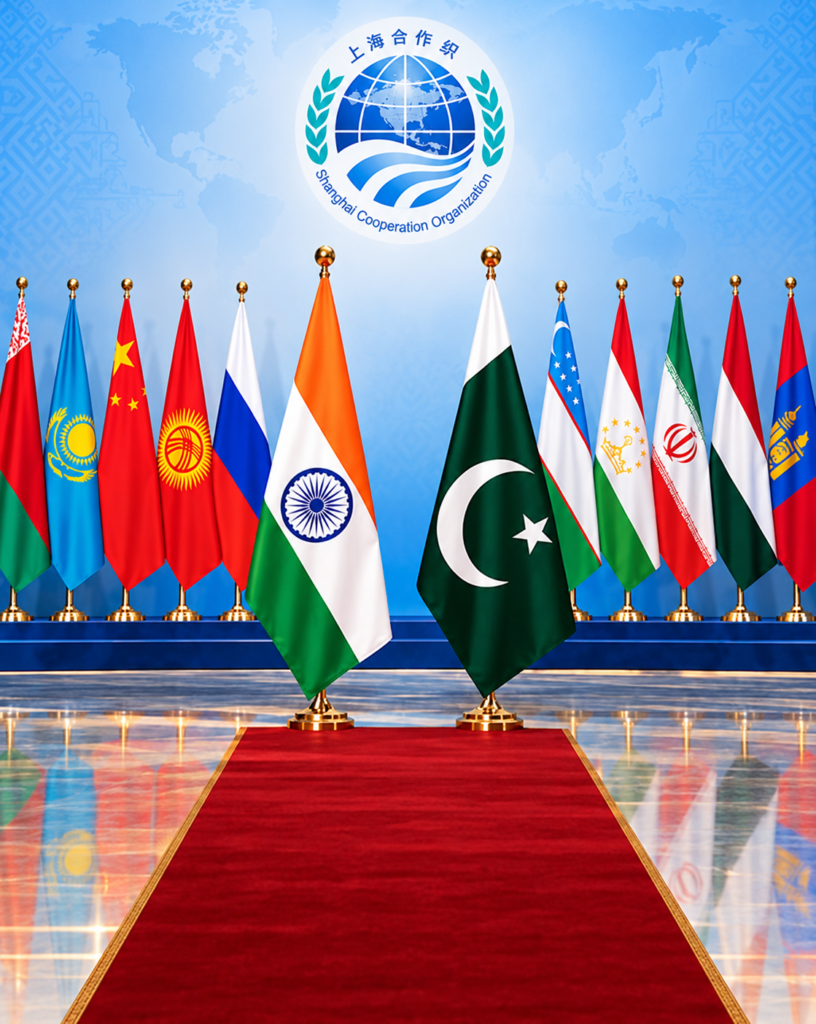
India became a full member in 2017. Pakistan joined in the same year. The organisation also includes China, Russia, Iran, Belarus and four Central Asian republics: Kazakhstan, Kyrgyzstan, Tajikistan and Uzbekistan.
For New Delhi, disengagement from Pakistan across every multilateral platform would carry costs of its own. It could limit India’s ability to influence discussions, shape institutional priorities and respond directly to positions advanced by Islamabad.
An analysis published by The Indian Express earlier this month, following an Indian official’s visit to Islamabad for an SCO coordinators’ meeting, highlighted this dilemma. The newspaper quoted an Indian official familiar with the strategy as saying: “If you are not part of the table, you are on the menu.”
The remark concerned India’s participation in the SCO process, but its broader relevance is evident. India can maintain restrictions on bilateral engagement while continuing to participate in an organisation whose work requires contact among all its members.
The SCO’s consensus-oriented framework also makes sustained engagement important. India’s interests in regional connectivity, economic cooperation and security cannot always be pursued without interacting with countries with which it has serious disagreements.
This does not mean that multilateral participation will resolve those disagreements. It means that India has reasons to remain engaged despite them.
A cultural forum, not a peace initiative
The nature of the November gathering is equally important. The Civilisational Dialogue Forum was proposed by Prime Minister Narendra Modi at the SCO summit in Tianjin in September 2025. Defence Minister Rajnath Singh subsequently announced that India would host the initiative while addressing the SCO Council of Heads of Government in Dushanbe on October 20, 2026, according to The Indian Express.
The initiative seeks to provide a platform for cultural exchanges among the organisation’s members. Such engagement can create opportunities for contact between countries whose political relations are troubled. Shared histories, literary traditions and cultural practices can sometimes sustain communication when formal political dialogue is limited.
But cultural diplomacy has its limits. A meeting devoted to civilisational connections cannot, by itself, address the political and security disputes that have brought India-Pakistan relations to their present state.
Nor should the presence of a Pakistani minister in New Delhi be interpreted as proof that either government is ready to resume comprehensive bilateral talks. That conclusion would require evidence of a separate political decision, a defined agenda and a willingness to address the underlying disputes.
For now, the invitation establishes only that Pakistan has been asked to participate in a multilateral cultural initiative. Whether Khichi attends, and at what level Pakistan chooses to be represented, remain open questions.
Larger diplomatic calculation
There is another dimension to India’s decision. Pakistan is scheduled to host the SCO summit in Islamabad in August 2027. India must therefore prepare for further engagement with Pakistan through the organisation, irrespective of the state of bilateral relations.
The invitation to the Delhi forum may be viewed as part of this continuing institutional process rather than as an isolated diplomatic gesture. India has already sent a senior official to Islamabad for the SCO national coordinators’ meeting under Pakistan’s 2026–27 chairmanship. These engagements demonstrate that multilateral obligations continue even when political relations remain frozen.
The question is whether such limited contact can eventually create space for a wider diplomatic conversation. At present, there is insufficient evidence to suggest that it will. The invitation may facilitate a ministerial visit and allow officials to interact, but neither outcome would automatically amount to a reset.
For New Delhi, the immediate task is to separate participation from normalisation. It can engage Pakistan where institutional requirements and Indian interests demand it, while maintaining its stated position on terrorism and other security concerns.
For Islamabad, accepting the invitation would similarly offer an opportunity to participate in a regional forum without necessarily changing its bilateral position towards India.
The larger lesson is that diplomacy does not always move in a straight line. Countries can cooperate in one setting while remaining adversaries in another. Such engagement is neither inherently conciliatory nor necessarily contradictory; its significance depends on the purpose, terms and consequences.
India’s invitation to Pakistan is best understood as a test of disciplined multilateral diplomacy, not a breakthrough in bilateral relations.