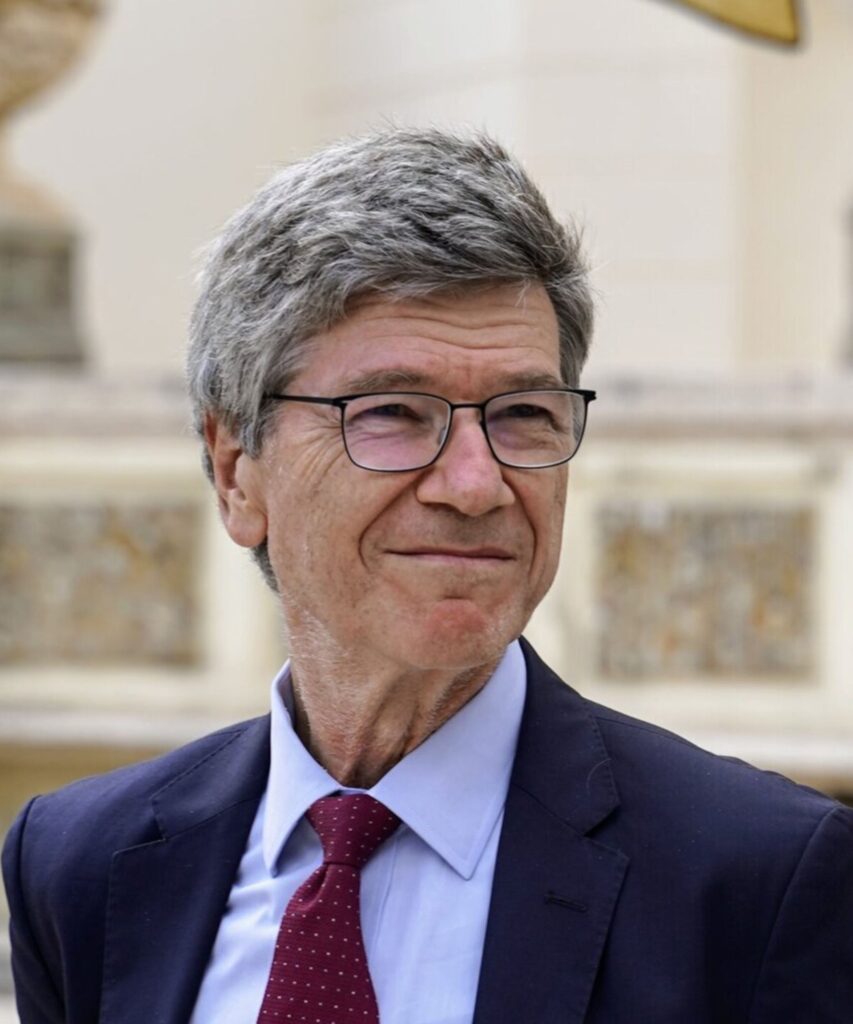
India must invest in its young people, rethink its strategic dependence on Washington and work with Beijing to shape a multipolar world, says Jeffrey D. Sachs, one of the world’s leading development economists and currently a professor at Columbia University. In an interview with India Dossier, Prof Sachs argues that India’s political leadership must deliver quality education, decent jobs and better public services or face mounting public pressure. He questions the strategic logic of India’s participation in the Quad, urges New Delhi to settle its disputes with China and calls for a UN-centred international order. Excerpts:
India Dossier: Are recent movements against the Modi government signs of a deeper shift in Indian politics, or are they still fragmented expressions of discontent? What role do young Indians play in the future of anti-government mobilisation?
Jeffrey Sachs: The youth protests are real. India is not serving its young people adequately because public education is very weak. Without quality education, there is no reliable pathway to a better future or decent jobs for hundreds of millions of young people. Any government in India must chart a path to mid-century based on high-quality education and good jobs.
Has Modi’s image of political invincibility been weakened by the recent movement? Do you think the Narendra Modi era is in decline?
India’s open political system will put pressure on any government going forward: deliver high-quality public services and infrastructure, or get out of the way. Indian governments will need to up their game to meet these legitimate public demands in a highly competitive world.
Is the Modi model of centralised leadership reaching its institutional limits? Does a political system built around one dominant leader retain the flexibility to respond to dissent, regional demands and changing public expectations?
Governments everywhere need to draw on expertise and plan ahead. Look at China, with its extraordinary leap in high-tech innovation, based on excellent national planning, high-quality education and private entrepreneurship.
What is the BJP likely to become in the post-Modi era? Could it remain a dominant national party?
I am sure India’s political landscape will remain highly competitive. The world’s most populous country will demand quality, integrity and results from its political leadership.
Has America become India’s most consequential strategic liability? Tariff threats and pressure on India over its Russian oil purchases have exposed the risks of dependence. Is India paying too high a price for its partnership with the United States?
India should not rely on the United States and should not be part of US security structures such as the Quad. India will need to rely on itself and maintain positive relations with all other regions: China, Russia, Iran, the Arab nations, Africa, the US, the EU and Latin America.
The US is no longer a world hegemon, if it ever briefly was one in the 1990s, and will decline in importance over time. India should choose partners that want a peaceful, multipolar world. India’s dalliance with Israel is also deeply misguided. Israel, sadly, has committed genocide in Gaza.
You have argued on several forums that India should deepen its engagement with China. Is that strategic realism or wishful thinking? Can New Delhi and Beijing build a durable partnership while their border dispute, strategic rivalry and mutual suspicions remain unresolved?
China and India share the most basic objective: a truly multipolar world in which countries cooperate on urgent issues such as climate change, AI governance and peace.
India should leave the Quad, China should support India’s bid for a permanent seat on the UN Security Council, and both countries should pursue a peaceful settlement of outstanding issues. If they work closely together, the economic and geopolitical benefits will be profound.
Is the American-led world order now beyond repair? Is Donald Trump dismantling an international system that Washington itself built, or merely accelerating the decline of an order already weakened by its own contradictions?
Trump is accelerating the decline of the US-led order, but the fundamental reason for that decline is the rise of Asia, including China, India, ASEAN and Central Asia. Asia does not want to be dictated to by the US, which accounts for only 4 per cent of the world’s population, compared with 60 per cent in Asia.
What would a credible endgame for the war in Ukraine look like? Which concessions, security guarantees and political compromises would be necessary for a durable settlement, and which would be unacceptable?
Ukraine should be neutral, and NATO should renounce further expansion eastwards into Ukraine or other countries. An armistice line should bring the fighting to an end, and Ukraine should become a candidate for European Union membership as a neutral country. Russia is right to resist NATO’s presence on its borders with Ukraine and Georgia.
Is the conflict involving Iran and the United States exposing the limits of American military power? Can Washington achieve lasting political outcomes through military action without a viable diplomatic settlement? What are the implications for global energy security?
The United States’ war on Iran is illegal, immoral and a military failure. It exposes, first, the foolishness and recklessness of the United States and, second, the lack of planning and rational decision-making.
The war should stop. America’s friends should tell the United States to “sober up” and stop its “drunk driving” in the Middle East. Most countries grovel before the United States. Instead, they should tell it to stop behaving recklessly.
Who is better placed to shape the next world order: the United States, China or a coalition of emerging powers? Give us your ranking, and explain what could change it.
Asia and Africa together will account for around 80 per cent of the world’s population later this century. The United States and the EU will account for well under 10 per cent.
The BRICS countries, which represent nearly 50 per cent of the world’s population and speak for emerging and developing countries (EMDCs), therefore have a huge role to play. That is also why China and India should work together to build a multipolar world. Good relations with the United States and the European Union are desirable, but not at the expense of good relations with China and the other BRICS partners.
Is India becoming a global power without acquiring the economic capabilities of one? What is the biggest gap between India’s diplomatic ambitions and its actual industrial, technological and human-development capacity?
India is on the right track but needs to upgrade education, science, technology and physical infrastructure. These should be the government’s top priorities.
If you were advising Prime Minister Narendra Modi today, what single foreign-policy decision would you urge him to make differently? Not a general principle, but one specific decision that could materially improve India’s position over the next five years.
Work with China to support the United Nations, secure India a permanent seat on the UN Security Council, resolve the border disputes with China and promote UN-based multilateralism. These are really all part of one objective: partnering with China to build a UN-centred multilateral world.
Can India maintain good relations with Washington, Moscow and Beijing simultaneously?
The United States needs to overcome its mistaken belief that “you are with us or you are against us”.
Does India need a new economic doctrine for a protectionist world? Should it prioritise export-led manufacturing, import substitution, regional trade integration or a combination of all three?
India should prioritise a green and digital future in both manufacturing and services, supported by open trade with emerging and developing countries. An outward-oriented approach will be vital.
It would be a good idea for India to join the Regional Comprehensive Economic Partnership (RCEP), which currently includes the 10 ASEAN countries, along with China, Japan, South Korea, Australia and New Zealand.