A government school is where the Republic makes its first promise to a child: that her future will not be decided by her parents’ income. Today, that promise is fraying. India has built the world’s largest school system, yet its public core is losing schools, students, teachers and, most dangerously, public trust. The crisis is not a shortage of schemes; it is a failure to convert entitlements into meaningful, everyday learning.
Why primary schools bear the burden
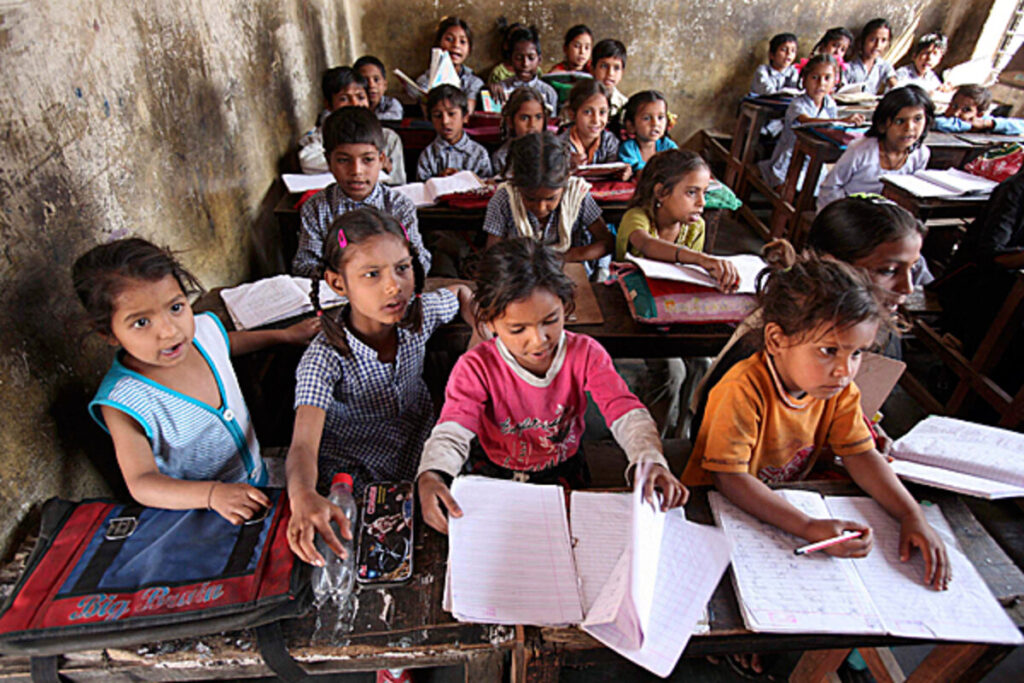
Primary education is where cognitive foundations, language and numeracy are formed. It is also where India’s institutional neglect is most visible. Thousands of schools still operate with one teacher managing multiple grades; UDISE+ 2025–26 records 1,00,843 single-teacher schools across all management categories. ASER also found that two-thirds of classrooms in Classes I and II in government primary schools are multigrade.
The teacher problem is not merely numerical. A Parliamentary Standing Committee found about 10 lakh vacancies in Samagra Shiksha-funded schools, around 7.5 lakh at the elementary level. National pupil-teacher ratios can look acceptable while rural, tribal and remote schools remain understaffed and urban schools have surplus staff. Teachers are also diverted to elections, surveys, census work and clerical reporting, weakening continuity in classrooms.
Infrastructure failures compound the problem: broken toilets, lack of drinking water, unsafe buildings, absence of electricity, inaccessible ramps and inadequate furniture. These are not cosmetic defects. They shape attendance, dignity, safety and girls’ participation.
Why good schemes did not fix learning
India has not lacked policy ambition. The Right to Education Act guarantees free and compulsory elementary education for children aged 6–14. PM POSHAN addresses classroom hunger. UDISE+ requires school registration and creates a national data system. Minimum teacher qualifications set professional entry standards. Yet these are largely entitlement- and input-focused measures. Meals can bring a child to school; they cannot fill a teaching vacancy. Free admission can secure enrolment; it cannot guarantee a trained teacher, a functioning toilet or grade-level reading. Registration can make a school visible in a database; it cannot certify that learning is occurring.
The system has too often measured what is easy—buildings, enrolment, meals and records—rather than what matters: whether a Class III child can read and calculate. Meanwhile, when middle-class families exit government schools, the political constituency for improving them weakens. Public schools then risk becoming institutions for those with no alternative, deepening inequality and eroding civic ownership.
School ‘Thik Karo’ moment
The Cockroach Janata Party’s #SchoolThikKaro campaign, launched on 15 August 2026, turned neglected school infrastructure into a public political issue. It encouraged citizens and parents to audit local government schools using a checklist covering drinking water, toilets, electricity, safety, pupil-teacher ratios, midday meals, funds and disability access.
Its spread was rapid—from Maharashtra and Rajasthan to Karnataka, Uttar Pradesh, Gujarat and Bihar. Organisers claimed audits in more than 15,000 schools by mid-October; these are campaign claims, not independently verified national figures. Still, the campaign’s democratic value is clear: it made broken toilets, missing water and absent teachers politically visible.
There were reported responses: repairs after local inspections in Maharashtra and Karnataka, Rajasthan’s announcement of a three-year infrastructure roadmap worth about ₹12,500 crore, Uttar Pradesh’s 14-point school checklist, and the appointment of 41 senior officers for district-level inspections in Rajasthan. These are administrative responses and announcements, not yet proof of durable national reform. Their real test lies in completed repairs, filled vacancies and improved learning.
Rajasthan’s decision to restrict outsiders’ entry and photography exposed the balance that must be struck. Child privacy and uninterrupted lessons matter; so does transparent, supervised inspection and public disclosure of corrective action. The right response to civic audits is not exclusion but an official grievance-and-repair system with deadlines and published outcomes.
States that prove it is possible
Kerala, Punjab, Mizoram and Sikkim show that decline is not destiny. Kerala’s long public-schooling tradition, library movement and local-government involvement have made education a social expectation. Punjab led PARAKH 2024 in Grade III language and mathematics and has pursued Mission Samarth to strengthen foundational competencies.
Mizoram records some of the strongest government-school reading outcomes among Class V pupils, while Sikkim has shown improvement in Class VIII reading. But success is uneven: Mizoram’s primary retention was only 55.1 per cent in 2024–25, and Sikkim’s upper-primary GER was 75.8 per cent. The lesson is not to copy a state model mechanically; it is to build safe, well-staffed, community-anchored schools with measurable learning improvement.
Public School Education Vision 2030
India can repair its public-school system by 2030, but only through mission-mode delivery, not another cycle of announcements. Ten commitments should anchor the agenda.
1. Protect the neighbourhood school. No closure or merger without a published child-impact assessment, parental consultation, safe transport and proof that the receiving school has the capacity, teachers and functioning facilities.
2. End single-teacher primary schools by 2028. Publish school-wise vacancies, recruit through transparent calendars, deploy teachers equitably to rural and tribal schools, and provide incentives for service in difficult areas.
3. Make foundational literacy and numeracy the headline metrics. Ensure every child achieves basic reading and arithmetic proficiency by Class III through daily reading time, diagnostic assessment, structured lessons and small-group remedial support.
4. Universalise quality preschool education. Integrate Anganwadis and Balvatikas with primary schools, train early-childhood educators, use home languages and identify learning difficulties early.
5. Guarantee a basic-facilities floor. Every school must have a safe building, drinking water, usable toilets, electricity, ventilation and disability access by 2028, with annual maintenance funds and named accountable officials.
6. Protect teaching time. Legislate against the routine deployment of teachers for non-academic duties; every lost teaching day must be recorded and compensated.
7. Strengthen PM POSHAN as a nutrition-plus-learning programme. Ensure hot, hygienic, diverse meals, local social audits, timely payments, health screening and links to attendance and learning.
8. Build school complexes without closing village schools. Let nearby schools share laboratories, libraries, subject teachers and training, while retaining accessible early-grade provision close to home.
9. Empower parents without politicising schools. Give School Management Committees real authority over maintenance, meal quality, attendance and grievances, supported by digital complaint systems with mandatory response timelines.
10. Fund delivery and publish results. Move towards the long-promised target of raising public expenditure on education to 6 per cent of GDP, prioritise deprived districts, release grants predictably, and track attendance, transition, learning and equity gaps—not merely spending.
Choices before India
India’s education crisis is not primarily a crisis of money alone, though underfunding matters. It is a crisis of institutional seriousness: the country has built enrolment, entitlements and data systems, but has not consistently delivered reliable classroom learning, safe schools and a professional teaching culture.
The 94,000-school contraction should be treated as a warning, not merely a statistic. If public schools continue to decay, India will deepen inequality, waste its demographic dividend and weaken democratic citizenship. But ASER’s evidence of post-pandemic recovery in government schools proves that improvement is possible.
By 2030, India should aim not merely to keep children in school, but to make government schools the first choice of every family. That requires treating every primary classroom as a national priority—and every broken toilet, absent teacher and child unable to read as a policy failure that can, and must, be fixed. The blackboard can be reclaimed, but only if the promise of public education is translated into results.