
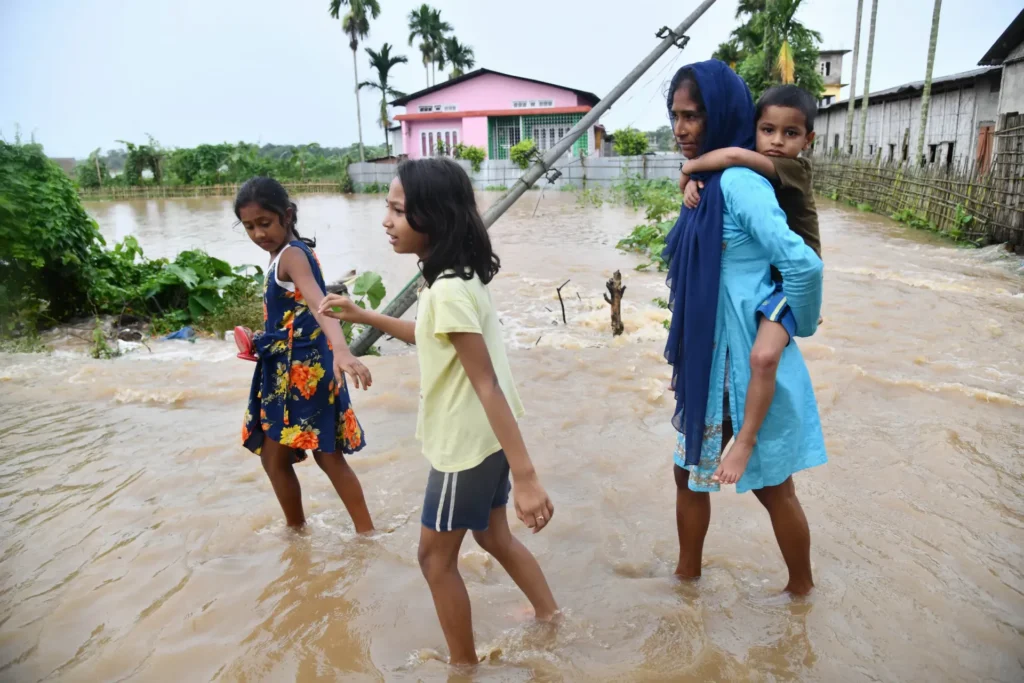
South Asia’s Climate Challenges and Impacts
South Asia brings together Bangladesh, Bhutan, India, the Maldives, Nepal, Pakistan and Sri Lanka, with nearly 2 billion people and an economy of roughly US$5 trillion. From the Himalayas to the Indian Ocean, the region contains major river basins, fertile plains, densely populated deltas, drylands, long coastlines and low-lying islands.
This geography makes South Asia deeply interconnected. Rivers cross borders, monsoon systems affect multiple countries, and economies are linked through trade, energy, infrastructure and migration. Yet the seven countries face different climate risks and development priorities. The challenge is therefore how national responses can work together across the region.
South Asia faces several common climate challenges: extreme heat, changing monsoon patterns, extreme rainfall, floods and droughts, Himalayan glacier and snowmelt, and sea-level rise, coastal erosion and salinity.
These risks affect health, agriculture and food security, water and energy systems, infrastructure, livelihoods and economic growth. Heat threatens health and labour productivity, while floods, droughts and changing rainfall disrupt agriculture and water supplies. Extreme weather damages infrastructure and increases economic losses, while climate pressures can also contribute to displacement and migration.
However, the impacts differ significantly by country.
India faces severe heat stress, agricultural disruption and rising electricity demand, particularly as cooling needs increase.
Bangladesh faces coastal flooding, cyclones, salinity and displacement, with major consequences for agriculture, freshwater and densely populated coastal communities.
Pakistan faces major flood losses alongside water scarcity, agricultural disruption and fiscal pressure from repeated climate disasters.
Nepal faces glacier-related hazards, landslides and floods that threaten mountain communities, infrastructure and hydropower.
Bhutan faces glacial lake outburst floods, hydropower risks and ecosystem vulnerability, linking climate resilience closely to its environmental and economic model.
Sri Lanka faces drought, floods, food and water stress, while climate pressures interact with energy vulnerability and economic constraints.
The Maldives faces sea-level rise, coastal erosion and saltwater intrusion, creating risks to infrastructure, freshwater and the long-term habitability of its islands.
Current National Climate Policy Responses and Policy Gaps
The seven countries have developed national climate responses reflecting their different realities, but significant gaps remain between policy ambition and implementation capacity.
India is pursuing net zero by 2070 through the Panchamrit framework, renewable-energy expansion, the Green Hydrogen Mission, energy efficiency and electric mobility. Policy gap: India must decarbonise while meeting rapidly rising electricity demand and maintaining affordable and reliable energy, leaving continued coal dependence as a major challenge.
Bangladesh prioritises adaptation through its National Adaptation Plan and Bangladesh Delta Plan 2100, alongside cyclone preparedness, coastal protection and climate-resilient agriculture. Policy gap: adaptation needs exceed domestic financial and institutional capacity.
Pakistan emphasises adaptation, disaster-risk reduction, water management and resilience. Policy gap: repeated climate disasters, combined with fiscal constraints, limit investment in resilient infrastructure, recovery and long-term adaptation.
Nepal combines adaptation, ecosystem-based approaches and hydropower development. Policy gap: climate hazards increasingly threaten the infrastructure and hydropower systems on which future economic development depends, while fiscal capacity remains limited.
Bhutan combines forest conservation, climate resilience and hydropower development. Policy gap: it must protect fragile mountain ecosystems and hydropower assets while continuing to create economic opportunities.
Sri Lanka is pursuing renewable energy, energy transition, adaptation and sustainable transport. Policy gap: limited fiscal space restricts investment in climate-resilient infrastructure and the energy transition.
The Maldives focuses on coastal adaptation, resilient infrastructure, renewable energy and climate diplomacy. Policy gap: its extreme exposure to sea-level rise requires financial and technical resources far beyond what its low-emission economy can provide.
The broader issue is clear: South Asia does not lack climate policies; it lacks sufficient capacity, finance, technology and coordination to implement them at the required scale.
What Countries in South Asia Can Learn from Each Other
Each country has experience that can strengthen others. Bangladesh offers lessons in cyclone preparedness, early-warning systems and coastal adaptation. India provides experience in renewable energy, energy efficiency and climate technology. Nepal and Bhutan offer knowledge of Himalayan ecosystems, hydropower and mountain resilience. Pakistan provides lessons from repeated floods and disaster recovery. Sri Lanka demonstrates the challenge of energy transition under economic constraints, while the Maldives shows how climate diplomacy can elevate the concerns of highly vulnerable countries.
The opportunity is to turn these different experiences into shared regional knowledge and practical capacity.
Many of South Asia’s climate risks cannot be contained within national boundaries. The Himalayas feed river systems shared by several countries, while monsoon systems influence the region as a whole. Floods, droughts and disasters can affect food supply chains, energy systems, infrastructure and migration across borders.
This creates a fundamental policy gap: climate risks are regional, but responses remain largely national.
India: From National Climate Leader to Regional Enabler
India has the economic scale, technology and institutional capacity to help connect national climate responses across South Asia.
Its role should not be to solve the climate problems of neighbouring countries, but to act as a regional enabler by sharing satellite and weather capabilities, supporting cross-border electricity connectivity, providing technical expertise, strengthening disaster-response cooperation and helping mobilise climate finance.
India’s climate leadership should therefore be measured not only by what it achieves domestically, but also by whether its capabilities help neighbouring countries become more resilient.
South Asia’s climate future will depend on how effectively countries manage their different national risks while responding to challenges that cross borders. National climate policies remain essential, but regional coordination can make those policies more effective.
Recommendations for Fostering Regional Climate Action
South Asian countries need to move beyond separate national responses and accelerate coordinated regional action. This requires cooperation in areas where shared climate risks create clear opportunities for countries to pool information, infrastructure, finance, technology and emergency capacity. Seven priorities stand out:
1. Accelerate cross-border climate and water data sharing.
Create shared systems for rainfall, river flows, glaciers, snow conditions and extreme-weather data to improve regional risk assessment.
2. Accelerate regional early-warning systems.
Connect national forecasting and disaster-management systems for floods, cyclones, heatwaves and droughts so warnings can move rapidly across borders.
3. Accelerate regional electricity connectivity and clean-energy trade.
Expand cross-border transmission and renewable-energy trading, allowing India’s solar and wind capacity to complement Nepal and Bhutan’s hydropower.
4. Accelerate climate-resilient infrastructure standards.
Develop common standards for roads, bridges, hydropower, cities and water systems based on future climate risks.
5. Accelerate access to climate finance.
Build regional capacity to develop bankable adaptation and mitigation projects and access international climate finance, particularly for countries with limited institutional capacity.
6. Accelerate climate technology and knowledge sharing.
Strengthen cooperation among governments, universities and research institutions on satellite monitoring, climate modelling, resilient agriculture, renewable energy and disaster management.
7. Accelerate regional disaster-response capacity.
Establish common protocols for emergency assistance, search and rescue, medical support and humanitarian logistics following major climate disasters.
The objective is to move from separate national responses towards practical regional systems that share information, energy, finance, technology and emergency capacity.