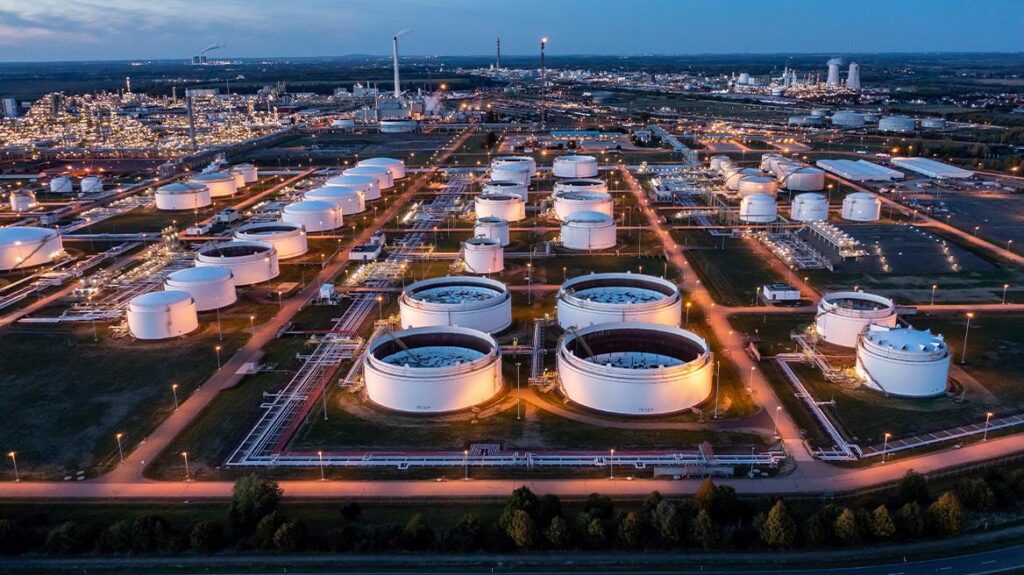
An aerial view of oil-storage infrastructure in India. Strategic reserves offer only limited protection against prolonged disruption
On May 24 in New Delhi, External Affairs Minister S. Jaishankar, standing next to US Secretary of State Marco Rubio, was asked about India’s energy sourcing under the Trump administration. He identified four key factors: multiple sources, large capacity, dependability and affordability. Since then, these factors have faced increasing challenges. Last month in New York, they faced their toughest test to date.
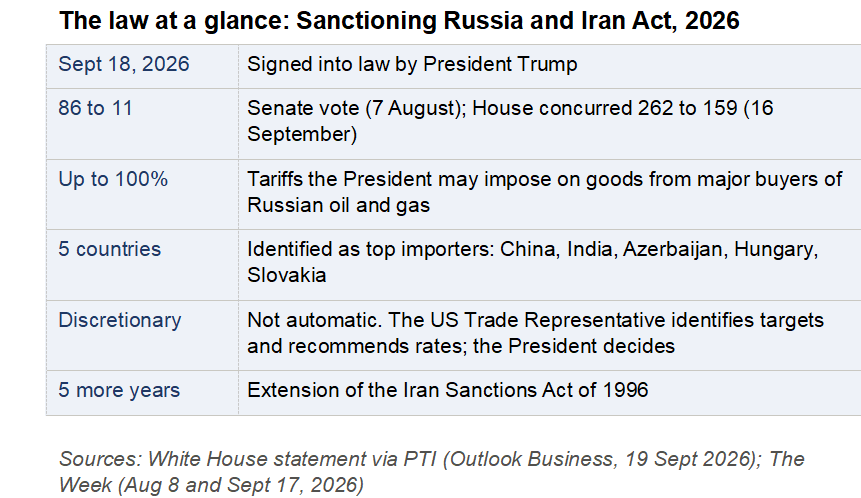
On September 18, President Donald Trump signed the Sanctioning Russia and Iran Act. It authorises tariffs of up to 100 per cent on countries that continue to buy Russian oil and gas, naming India and China among the principal buyers. The tariff is not automatic. The US Trade Representative identifies targets and recommends rates; the President decides whether, when and how much. Five days after the signing, on the sidelines of the United Nations General Assembly, Jaishankar met Rubio and, in his own words, “reiterated India’s interests and concerns” about the law. The Ministry of External Affairs restated its position: energy security for 1.4 billion people, through diversified sourcing and evolving market dynamics.
In plain terms, the message is this. India’s energy policy is not a loyalty test between Washington and Moscow. It is a matter of arithmetic. For an economy that imports most of its crude, energy security means ensuring that no single supplier, shipping corridor or political decision can hold the economy hostage. The same logic holds for any economy that depends on imports, whether of food, fertiliser, rare earths or talent.
Let us look at the sequence of events. In 2022, after the West sanctioned Moscow, Europe pulled West Asian crude towards itself, and much of what was left for India was Russian. Jaishankar has said more than once that Washington itself asked New Delhi then to buy Russian oil and keep world prices from spiking. In August 2025, Washington imposed a 25 per cent penalty on those purchases, on top of a 25 per cent reciprocal tariff, while China was spared. The penalty was withdrawn only in February this year. In June, speaking in Finland, Jaishankar said India buys on cost and availability, and that nobody should pretend a grand principle was at work. Congress has now handed the President a statutory instrument far heavier than the one he withdrew.
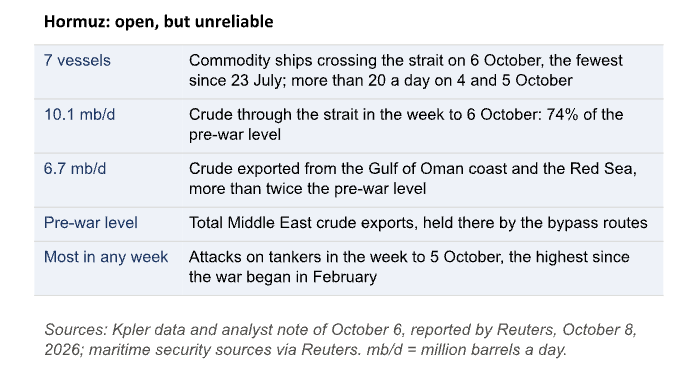
Then comes the Gulf. Hormuz is not shut. It is something more corrosive: it is unreliable. On October 6, analytics firm Kpler counted seven commodity vessels crossing the strait, the fewest since July 23, compared with more than 20 a day earlier that week. Crude through the strait stood at about 10.1 million barrels a day, 74 per cent of its pre-war level. The week before had brought more attacks on tankers than any since the fighting began in February. A strait does not need to close for energy security to deteriorate. Unpredictable passage, costlier insurance and longer voyages do the damage quietly.
The same data carry a second message. Exports from the Gulf of Oman coast and the Red Sea rose to 6.7 million barrels a day, more than twice their pre-war level, keeping total Middle East crude exports at normal levels. ADNOC moved crude to Fujairah and Sohar, beyond the strait. Saudi Arabia sent barrels west to Yanbu. The producers who kept their customers were those who sold a route, not merely a barrel.
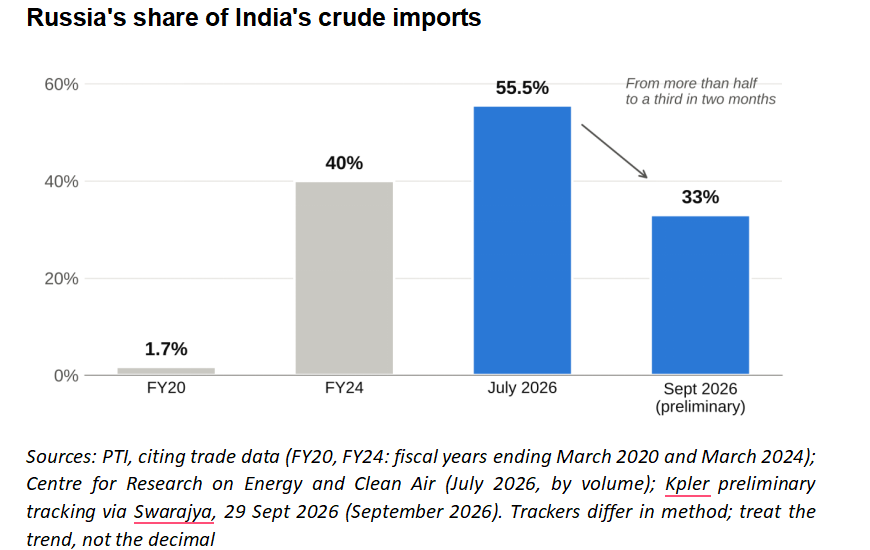
Now compare India’s own numbers. In July, India imported a record 2.8 million barrels a day of Russian crude, more than half of its total. By September, preliminary tracking put Russian volumes near 1.75 million barrels a day, about a third of a larger total of 5.3 million, with Middle Eastern supply filling the gap. India rebalanced in two months, before any new tariff took effect. Part of that was choice; part was Chinese refiners outbidding India for Russian barrels. Either way, the gap was filled.
What does it mean? The portfolio is working.
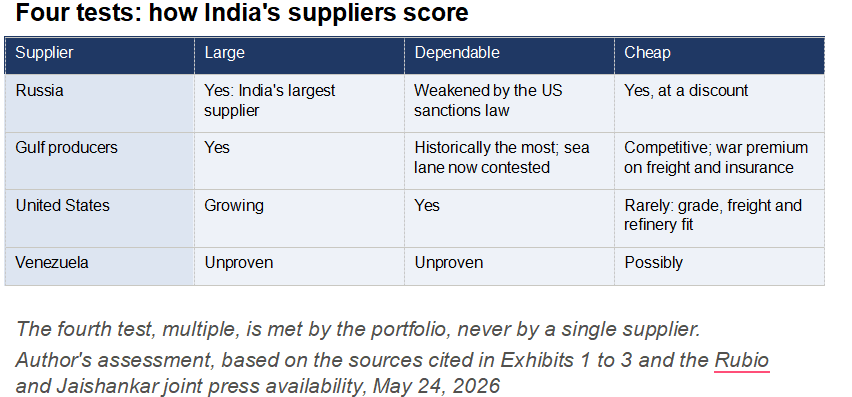
Let us now look at those policy drivers against the map. They are requirements, not categories, and they pull against one another. Russia is large and cheap, but Washington has made it less dependable. The Gulf is large and historically the most dependable, but its main sea lane is now contested. American crude is dependable and growing in India’s mix, but its landed cost turns on grade, freight, insurance and refinery fit, and it is rarely the cheapest option. Venezuela, whose foreign minister Jaishankar met at UN headquarters on 26 September, is a possibility; no contract, volume or timetable was announced. A cheap supplier may carry political risk. A large one may depend on a vulnerable corridor. A dependable one may cost more. Not one source passes all four tests every day. That is why ‘multiple’ comes first.
I will not read the New York position as defiance of America. I will read it as arithmetic.
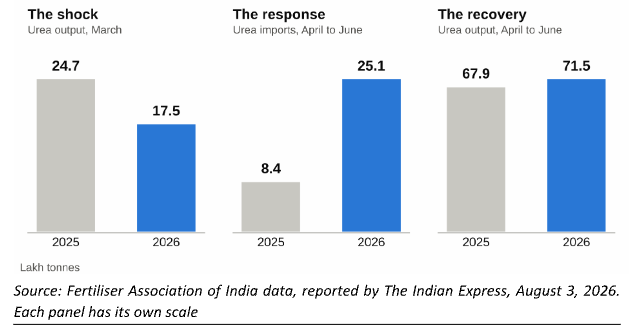
Now let us consider who pays when the arithmetic fails. In his address to the General Assembly on September 26, Jaishankar spoke of ‘a weaponisation of everything’ and a 4F crisis facing the developing world: food, fuel, fertiliser and finance. India has already lived through this. Before the war, Qatar and the UAE supplied about 54 per cent of its LNG, the feedstock for urea. When cargoes stopped, urea output fell to 17.5 lakh tonnes in March, down from 24.7 lakh tonnes a year earlier. The shock was absorbed. Diversified gas buying and urea imports, which tripled in April to June, lifted output above the previous year. The farmer did not see the bill. The exchequer did.
Fertiliser: the shock, the response, the recovery
Rabi sowing is now underway, and phosphatic fertiliser sourcing was never widened as much as urea sourcing was. Diesel runs the pump set in a Bathinda wheat field and the truck that carries onions out of Lasalgaon. Freight and insurance on a tanker become the price of cooking gas in a Patna kitchen. A US tariff would fall on Indian exports, not on crude. Its real cost is subtler: it would narrow the very portfolio that saved the kharif crop.
From the Gulf, I observe a calculation that deserves more attention in Abu Dhabi and Riyadh. India’s energy security has been a Gulf story for fifty years, and Saudi Arabia and the UAE are home to some eight million Indians. When New Delhi says ‘multiple’, it tells every supplier that dependability must now be earned, voyage by voyage.
The Gulf’s opportunity is to sell resilience, not just crude. ADNOC already holds about 5.86 million barrels of capacity in India’s strategic reserve caverns at Mangaluru, and in May agreed to raise its crude stored in India to as much as 30 million barrels, with India exploring storage of its own at Fujairah. That matters because India’s strategic reserves cover only about nine and a half days of net imports. Storage on Indian soil, export routes that bypass Hormuz, term contracts flexible enough to absorb a war premium, crude grades matched to Indian refineries: producers that offer this package will hold their share as American, African and Latin American barrels compete for it.
For Washington, the test is simple. India has already increased its purchases of American energy, and its foreign minister said so publicly beside the Secretary of State. Will the new powers accelerate that shift, or will they raise India’s costs and teach New Delhi to lean less on any single partner, America included? Coercion that makes a partner’s choices costlier without making American supply the obvious answer is a poor bargain.
The law grants power; it does not compel its use. With midterm elections on November 3 and American diesel above $6.50 a gallon in September, a measure that pushes world crude higher is a hard sell in farm states. I expect the tariff to stay in reserve, at least until the ballots are counted. But India’s policy should not rest on that expectation. It should rest on the arithmetic.
Multiple, large, dependable, cheap. Four words that ask no supplier for loyalty and promise none in return. They are now the test by which every energy partnership with India will be judged.