Every autumn, the rising flames across the paddy fields of Punjab and Haryana expose a deeper failure in India’s agricultural policy: we are asking farmers to diversify while continuing to reward the very cropping pattern we want them to change. Paddy cultivation in these states has contributed to mounting pressure on groundwater and other natural resources, while stubble burning adds to seasonal air pollution. India’s “−5, +10” strategy, which aims to reduce the area under rice by 5 million hectares while increasing rice production by 10 million metric tonnes, seeks to address this imbalance by creating space for pulses, oilseeds, millets and other crops that can improve farm incomes, conserve resources and reduce import dependence. But farmers will diversify only when the economics make sense. Crop choices respond to incentives, not policy appeals. Here lies the central policy paradox: the government wants farmers to move away from paddy, yet its institutional support architecture continues to make paddy the more attractive choice.
For farmers, crop choice is not determined by the minimum support price (MSP) alone. It depends on the entire economic ecosystem: procurement, input costs, irrigation, electricity, market access, storage, processing and, above all, the certainty of earning a remunerative return. Nowhere is this more evident than in Punjab and Haryana. An ICRIER study (Singh et al. 2026) estimates that in 2022–23, paddy received input subsidies (fertiliser subsidy from the Centre, and power and irrigation subsidies from the states) of about ₹40,577 per hectare in Punjab and ₹52,388 in Haryana. For oilseeds, the corresponding figures were just ₹8,685 and ₹9,859, while pulses received ₹6,382 and ₹7,430, respectively.
Total Incentives towards Paddy vis-à-vis Other Kharif Crops in Punjab and Haryana
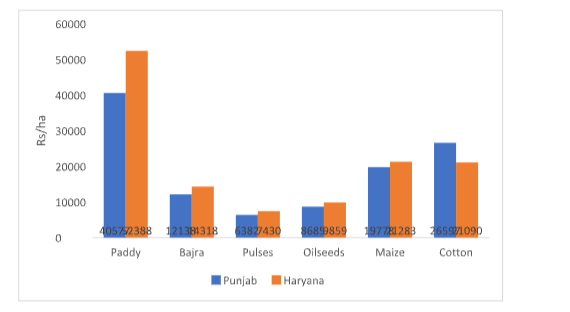
(Source: Reena Singh, Purvi Thangaraj and Ashok Gulati (2026). ICRIER report “Diversification to Augment Farmers’ Income and Promote Sustainable Agriculture in Punjab and Haryana”. ISBN: 978-81-998893-2-3)
These differences shape farmers’ choices. Paddy has an established ecosystem: subsidised electricity lowers the cost of groundwater extraction; fertiliser subsidies reduce input costs; procurement provides a relatively assured market; and well-developed mandis, storage and logistics reduce marketing risks. Many alternative crops lack comparable support. Farmers, therefore, are not necessarily unwilling to diversify. They are responding rationally to the incentives embedded in agricultural policy. The transformation of Punjab’s cropping pattern illustrates this clearly. In 1971–72, rice occupied just 0.39 million hectares (mha), or 7 per cent of the gross cropped area (GCA). By 2025–26, rice cultivation had expanded to 3.2 mha, accounting for 38 per cent of GCA.
The consequences are increasingly costly: groundwater depletion, soil degradation, environmental damage and rising public expenditure. Paddy is highly water-intensive, requiring 20–25 irrigations compared with just 4–5 for many alternative crops. Its dominance has placed severe pressure on groundwater in Punjab and Haryana. Annual extraction stands at an estimated 26.27 billion cubic metres (bcm) in Punjab and 12.72 bcm in Haryana, against recharge of only 18.6 bcm and 10.27 bcm, respectively. Consequently, 72.6 per cent of groundwater blocks in Punjab and 63.6 per cent in Haryana are classified as over-exploited (CGWB, 2025). Groundwater levels fell by 11.94 metres below ground level (mbgl) in Haryana and 10.89 mbgl in Punjab, representing the steepest declines among Indian states, between 2000 and 2022. The paddy-centric cropping pattern is therefore becoming a serious threat to long-term water security.
Paddy cultivation also has a significant environmental footprint. Flooded fields release methane (CH₄) through anaerobic decomposition, while synthetic nitrogen fertilisers generate nitrous oxide (N₂O). Over a 100-year timeframe, CH₄ and N₂O have global warming potentials of 27.2 and 273 times that of CO₂, respectively. Energy use and crop-residue burning add further emissions. Consequently, Punjab records the highest per-hectare GHG emissions from paddy cultivation in India—about 5 tonnes of CO₂ equivalent (t CO₂eq) per hectare, compared with the national average of 3.1 t CO₂e, followed by Haryana at 4.9 t CO₂eq per hectare (Singh and Gulati, 2025). Residue burning in both states also contributes substantially to air pollution and associated public-health risks. The intensive cultivation of high-yielding varieties of wheat and paddy has also driven heavy use of chemical inputs. Fertiliser application averaged about 250 kg per hectare in Punjab and 220 kg in Haryana in 2024–25 (FAI, 2026). Excessive nitrogen use, particularly relative to phosphorus and potassium, contributes to GHG emissions and nutrient losses, with nitrogen released into the atmosphere or leached as nitrates into groundwater, further increasing the risk of water contamination.
These developments illustrate the hidden environmental and social costs of agricultural growth in Punjab and Haryana and underscore the urgent need to transition towards more sustainable cropping patterns and production practices. Yet simply raising MSPs will not solve the problem. The government has increased MSPs for 14 kharif crops for 2026–27, with paddy’s MSP at ₹2,441 per quintal. But an announced MSP is not the same as an accessible price guarantee. The relevant question for a farmer is not, “What is the MSP?” but, “Can I actually sell my crop at or near that price?” Paddy and wheat have an answer. Pulses, oilseeds, maize and millets often do not. Diversification therefore requires more than higher MSPs. It requires procurement, aggregation, storage, processing, value addition and reliable linkages with private and institutional buyers.
There is also a strong economic case for compensating farmers for the environmental benefits of diversification. When a farmer shifts from paddy to a less water-intensive crop, reduces groundwater extraction or adopts climate-smart practices, the gains extend beyond the farm. These are public benefits, and farmers should not be expected to bear the transition costs alone. This is where policy needs to change. Governments should offer multi-year transition payments to farmers who voluntarily shift from paddy to pulses, oilseeds, maize or other crops suited to local agro-ecological conditions. Existing incentives are simply too small relative to the structural advantages of paddy. Punjab offers ₹17,500 per hectare for shifting from paddy to maize, while Haryana provides ₹25,000 for shifting to alternative kharif crops. The continued expansion of rice in both states suggests that one-time payments are insufficient.
A more credible signal would be a transition payment of at least ₹35,000 per hectare for five years. In 2022–23, the estimated gap in input subsidies between paddy and pulses was ₹34,195 per hectare in Punjab and ₹44,528 in Haryana. For oilseeds, the gaps were ₹31,892 and ₹42,528, respectively. Such payments need not create a permanent new fiscal burden. As farmers diversify, reduced consumption of subsidised electricity, fertiliser and irrigation could generate savings for governments. A portion of these savings could be repurposed as transition payments, shifting public support from crop-specific incentives towards more crop-neutral and sustainability-oriented support. The transition period should also be used to strengthen agricultural R&D, particularly for pulses and oilseeds, to improve productivity, climate resilience and profitability. This is critical for India not only environmentally but also strategically, given its dependence on imports of pulses and edible oils.
India’s Green Revolution offers an important lesson. Farmers rapidly adopted new technologies when policy aligned incentives through improved seeds, irrigation, fertiliser, credit, procurement and remunerative prices. Farmers respond to incentives. If India wants them to diversify, its policies must make diversification as economically credible as the rice-wheat system it is seeking to change.
India wants farmers to diversify. It is time for its subsidies to tell them the same.