Five baby orangutans, less than one year old and of unknown origin, found in a forest in Balasore, Odisha, thousands of kilometres from their native Southeast Asian rainforests, have brought the dark realities of wildlife trafficking into focus. Their rescue raises urgent questions about how they arrived in India, who was responsible, and what their future holds. Yet, beyond the investigation, there is a quieter question worth asking: what does an infant orangutan lose when it is separated from its mother?
The immediate answers may be food, warmth, protection and the familiarity of a trusted caregiver. But for orangutans, the loss can reach much further. For them, the forest is not simply a place to live; it is a world that must be learned. Being separated from a mother may mean losing access to years of experience through which a young animal learns to navigate its world, recognise opportunities and meet the demands of life in the forest. Wildlife trafficking is usually discussed in terms of animals captured, animals seized, smugglers apprehended and species threatened with extinction. These are essential measures of the scale of the crime. But they do not fully capture what happens to an individual animal when it is removed from its family and environment during a critical period of development.
A Childhood Measured in Years
Orangutans have one of the longest periods of mother-offspring association among non-human mammals. Young orangutans have the longest weaning period among non-human mammals and remain with their mothers for at least nine years. This extended childhood provides the time and opportunities needed to acquire the skills and ecological knowledge required for independent living. In their study of Sumatran orangutans, van Noordwijk and van Schaik (2005) examined the development of ecological competence, that is, the ability to meet the practical demands of survival in a particular environment, and found that physical maturity and behavioural competence do not necessarily develop at the same pace. An orangutan baby may learn to climb well before it becomes proficient at navigating the canopy, locating diverse foods or exploiting resources that require specialised handling. Thus, being physically capable of moving through trees does not automatically translate to knowledge about where to forage, which foods to seek or how to obtain them.
Much of this knowledge develops through repeated experience alongside the mother. More recently, in captive conditions, fathers have also been observed engaging in play and food sharing, with possible positive effects on infant development, growth, well-being and survival. However, it is the mother who is mostly involved in parental care and who is more than a source of nourishment and protection.

More Than Food: Learning How to Live
Research increasingly shows that young orangutans acquire important skills through observation and social interaction. They must learn to identify and process more than 200 food items, each presenting different challenges. While flowers and leaves can be eaten with little preparation, other foods demand more complex techniques, such as loosening bark and scraping it with their teeth to access the nutritious inner layers. Some foods require tool use, such as modifying sticks into brushes to extract honey from bee nests.
Orangutan mothers actively facilitate their offspring’s learning during the weaning stage by adjusting their tolerance according to the young animal’s age and the complexity of the food. Mikeliban and colleagues (2021), studying wild Sumatran orangutans, documented that mothers were willing to share complex food items and were most tolerant when their offspring were developing food-recognition and processing skills, especially when foods were difficult to process, particularly those requiring tools, thereby creating opportunities for young orangutans to encounter foods that may be difficult to access or process independently.
In contrast, mothers are less tolerant when sharing easily accessible foods, such as leaves that can be picked and eaten whole, and tend to stop sharing them once their offspring reach a certain age. Similarly, Jaeggi and colleagues (2010) found evidence that immature Bornean orangutans’ food choices resemble those of their mothers, and that observing extractive foraging was associated with increased practice of relevant skills.
The significance of these interactions extends beyond the immediate transfer of food. The mother provides access to experiences that may otherwise be difficult for an inexperienced youngster to obtain. The same principle applies to other aspects of forest life. Nest-building, for instance, involves selecting suitable locations and materials and arranging branches and leaves to create a sleeping platform high in the trees. Research published in 2025 on wild Sumatran orangutans linked observation of nest-building with increased practice and found evidence that knowledge about suitable tree species was socially transmitted.
Although nest-building skills are well developed by three years of age, young orangutans continue to share their mothers’ nests until they are weaned at around seven years of age. Learning also extends beyond the mother. As young orangutans mature, they may observe other individuals and acquire information from a wider social network, highlighting how early maternal association can provide a foundation for a more extensive process of social learning.
When Separation Interrupts Learning
What happens when an infant is removed from this environment before it has had the opportunity to acquire these skills?
An infant separated prematurely from its mother may lose opportunities to observe natural behaviours and learn the cultural practices and skills that are essential for survival. Maternal separation also removes a familiar source of security and social interaction during a prolonged developmental period. For a young animal already experiencing the stress of capture, transport and unfamiliar surroundings, this disruption may compound the challenges of rehabilitation.
For the five infant orangutans rescued in Odisha, keeping them alive is only the first challenge. Humans can provide food, shelter and veterinary care, and these may be essential to their survival. But survival is not the same as recovery. No amount of protection can replace years of learning alongside a mother. The real test of rehabilitation is not simply whether these infants survive, but whether they can acquire the skills they will need to live without us.
Rescue is the Beginning, Not the End
For the orphaned orangutans, whose parents may have been killed, their long-term welfare would require a broader understanding of what recovery entails. Where return to the animals’ native range is possible and appropriate, repatriation must be accompanied by careful planning and individual assessment. Returning an animal geographically closer to its habitat does not, by itself, restore the years of experience it may have missed.
Successful rehabilitation should therefore not be judged by physical survival alone. It must also consider behavioural development, opportunities to practise species-typical skills, appropriate social experiences and readiness for any eventual release. These assessments require expertise, time and resources, and not every animal will necessarily be suitable for release into the wild.
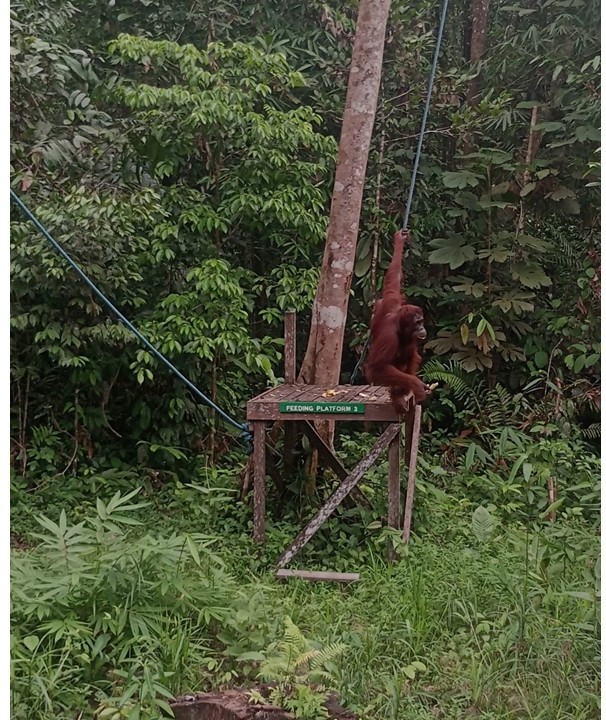
In this case, Semenggoh Wildlife Centre can serve as an important example. It is one of the world’s most successful rehabilitation centres for orphaned, injured and captive orangutans. Semenggoh in Sarawak, Borneo, has successfully rehabilitated and released multiple rescued, injured and orphaned orangutans into the protected forest reserve. A growing population of semi-wild orangutans is now thriving independently in the forest, returning only for supplementary feeding during the forest’s non-fruiting season.
This represents a genuine conservation breakthrough, as animals that had been in captivity could successfully transition to independent life in the forest. Its experience highlights what rehabilitation must ultimately aim for: not merely keeping animals alive in human care, but enabling them to develop the skills and independence needed to survive in their natural habitat.
The Cost is More Than We Can See
The cost of wildlife crime is therefore not measured only in the animals captured, or the populations threatened. It should also be measured in disrupted development, lost opportunities and the difficult work of rebuilding the foundations of an independent life.
This is why preventing wildlife trafficking matters so profoundly. Rehabilitation can save lives, but it cannot simply recreate the developmental history of an animal that has been removed from the wild.
The five orangutan babies found in Balasore need expert care, and their future should not be presumed before their individual needs and circumstances are understood. Saving an infant is the beginning of a responsibility, not its conclusion. For these young orangutans, recovery must mean more than surviving captivity. It must mean having the opportunity to learn the skills their mothers would have helped them acquire and, if circumstances permit, to become orangutans capable of living in the forest once more. Their story, however, invites us to look beyond the rescue itself.