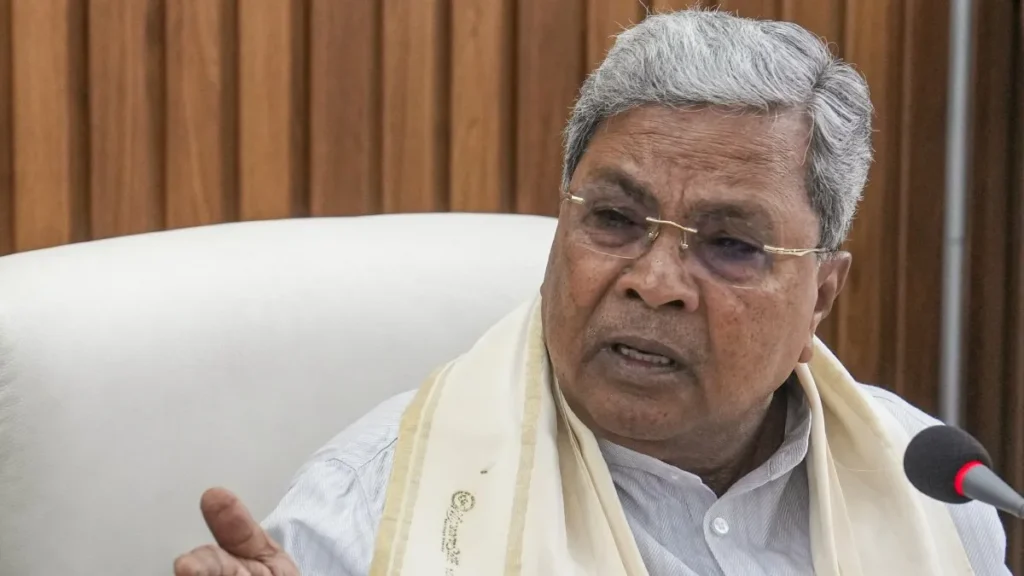
The controversy surrounding a sting operation targeting former Karnataka Chief Minister Siddaramaiah has escalated into a political and legal battle, with allegations of blackmail, questions over the role of a regional news channel and suspicions of internal Congress manoeuvring adding to the state’s factional tensions.
Siddaramaiah has publicly acknowledged that he was aware of the operation as far back as September 2026, and described it as a “concocted blackmail plot”. His response has shifted the focus from the contents of the purported sting tape to the circumstances surrounding its recording and broadcast, including the involvement of the managing editor of POWER TV.
An unusual feature of the controversy is that the purported sting reportedly centres on a conversation between a news anchor and a political functionary targeting a leader of her own party. The channel’s decision to place its own newsroom leadership in the middle of the controversy has also raised questions about the operation’s objectives.
Media observers say that in conventional investigative journalism, newsroom leadership generally seeks to maintain a distance from the subject of an investigation. In this case, however, the channel’s managing editor became part of the controversy itself, prompting questions about whether the recording served purposes beyond a conventional journalistic expose.
Political observers see the episode as an illustration of the increasingly contested relationship between media ownership and political power in Karnataka. The question being raised is whether the channel’s management exposed itself to public scrutiny as a form of protection against possible political or legal consequences, while retaining leverage in negotiations with those in power.
Who Benefits from the Sting?
For nearly two weeks, the controversy triggered acrimonious exchanges on television, with leaders from both the ruling and opposition camps facing allegations and counter-allegations. The resulting political storm brought the sting operation to the centre of public debate in the state.
The question of who stands to benefit most from the controversy has consequently assumed significance. The original analysis points to the ruling party and competing political factions as possible beneficiaries, while arguing that the episode has exposed deep divisions within Karnataka’s political establishment.
Siddaramaiah’s move to seek an injunction against the circulation of the material has added a legal dimension to the dispute. According to the analysis, the legal action weakened the alleged blackmail strategy by challenging the circulation of the material through legal channels.
Legal experts cited in the original argument view the subsequent aggressive broadcasting as a possible response to the failure of backroom leverage. They argue that when a political target refuses to yield to pressure, publicising a disputed recording can become a means of defending the operation by presenting it as investigative journalism.
The episode has therefore raised a broader question about the boundary between investigative reporting and the use of recordings as instruments of political pressure. The original analysis contends that sensationalised broadcasting can recast a compromised negotiation as a journalistic exercise, with press freedom invoked in defence of the channel’s actions.
These interpretations, however, remain allegations and assessments of the controversy rather than established findings about the channel’s motives.
Media Ownership and Political Factions
The channel’s confrontational approach has also brought Karnataka’s factional politics into sharper focus. The state has a highly politicised media environment in which news organisations are frequently perceived as being aligned with competing political interests.
The original analysis argues that the channel’s willingness to risk its own credibility suggests that its management may believe it has support from influential political factions capable of shielding it from state or legal retaliation.
Whether such backing exists, and who might be providing it, remains a central question in the controversy. The episode has also renewed scrutiny of the relationship between media organisations, political functionaries and competing centres of power.
Caste Equations Behind the Political battle
Beyond the legal dispute, the controversy has acquired significance because of Siddaramaiah’s position in Karnataka’s caste and electoral politics.
Siddaramaiah remains a leading figure of the AHINDA coalition, an acronym representing Alpankhyataru (minorities), Hindulidavaru (backward classes) and Dalitaru (Dalits). The coalition has been central to his political identity and his claim to represent socially disadvantaged communities.
The confrontation between Union Minister H. D. Kumaraswamy, associated with the dominant Vokkaliga political base in the opposition, and Karnataka Deputy Chief Minister D. K. Shivakumar, a prominent Vokkaliga leader within the Congress, has further intensified the political debate surrounding the sting.
The original analysis places the controversy within a wider struggle over caste representation and political influence, arguing that Siddaramaiah’s position has challenged established power structures in the state.
It contends that efforts to undermine his political standing could weaken the AHINDA coalition and create greater space for dominant socio-political groups to reassert their influence. The use of secret recordings to damage a leader’s credibility or force a change in leadership, it argues, can become a means of unsettling coalitions built around non-dominant caste groups.
This interpretation places the sting controversy within Karnataka’s longer-running contest over representation, leadership and access to political power. However, the claim that the operation was designed to weaken Siddaramaiah’s caste coalition remains an interpretation that would require further evidence to establish as fact.
Legal Battle and Questions Within Congress
The controversy has now moved into a phase involving legal proceedings, police questioning and competing allegations. Siddaramaiah and his allies have sought to frame the episode as an attempt at illegal blackmail rather than a lapse in governance.
The original article refers to injunctions against the circulation of allegedly false videos and to a police investigation involving newsroom heads. The proceedings have raised questions about the balance between investigating alleged wrongdoing and protecting the independence of the press.
The investigation’s outcome will be significant in determining the facts surrounding the recording and its circulation. Until those facts are established, the competing claims about the operation’s purpose and the individuals behind it remain contested.
The political fallout has also turned attention towards the Congress’s internal divisions. Following the exchange of allegations across party lines and Siddaramaiah’s public acknowledgement of the operation, his camp has reportedly begun pointing towards the possibility of an internal Congress role in the episode.
Questions are also being raised in political circles about whether the Congress high command in New Delhi had asked Siddaramaiah to step down for related reasons. The original article does not establish such a connection, but presents it as an issue being discussed amid the leadership tensions.
For the Congress leadership, the challenge is to contain factional rivalries without allowing them to destabilise the state government ahead of the next electoral contest.
With the next Assembly election less than 19 months away, the controversy has the potential to affect both the party’s internal equations and its political positioning. Siddaramaiah may have weathered the initial fallout from the September recording, but the legal proceedings and the allegations surrounding the operation could keep the issue alive.
The larger question is whether the sting controversy will remain a dispute over a recording and its circulation or develop into a wider confrontation over media accountability, factional politics and caste-based power in Karnataka.
For Siddaramaiah, the immediate challenge is to defend himself legally while maintaining his political position. For the Congress, it is to prevent the dispute from widening into a damaging internal conflict. And for the media, the episode raises questions about where investigative journalism ends and political leverage begins.