‘Give Us Back Our Future’
From Paris to Rome, from Berlin to Tirana, a generation raised amid a pandemic, soaring prices and rearmament is occupying schools and public squares. Its message to governments is blunt: you cannot ask us to accept a tomorrow poorer than your yesterday.
It all began in a schoolyard. In mid-September, in France, a group of high-school students folded their arms at the school gates, protesting against crumbling classrooms, teacher shortages and suffocating timetables. It looked like one of many protests destined to fade with the holidays. Six weeks later, it had become the most significant wave of social unrest the continent had seen in a generation.
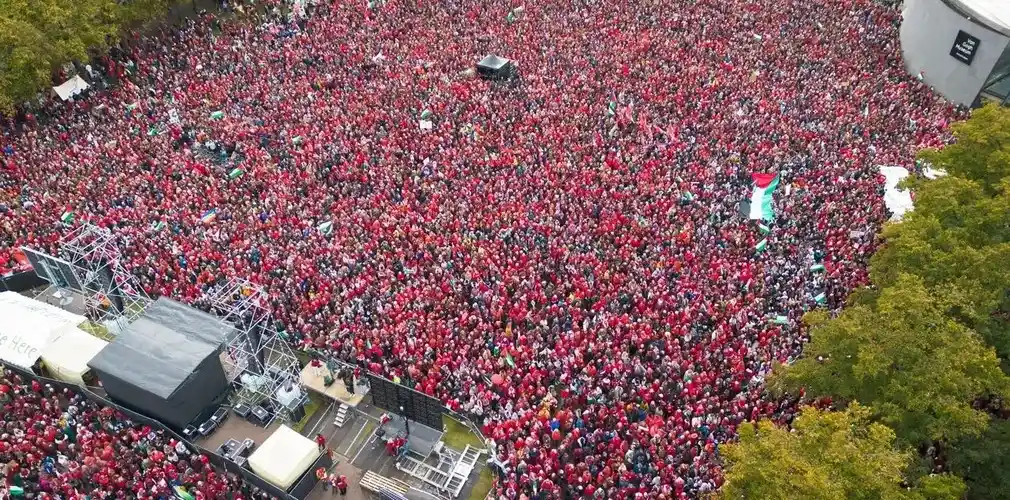
Europe has witnessed an escalation of street protests, violent confrontations and public disorder over the past few weeks, with more than 1,700 demonstrations and riots reported across 31 countries. France has emerged as a major flashpoint, recording more than 1,200 protests and riots, with over 500 arrests during the October 31 unrest. Germany has witnessed incidents of looting, arson and clashes, while Albania has seen protesters hurl petrol bombs and engage in violent confrontations with police. Spain, too, has witnessed street unrest, with 115 arrests reported on November 11. Tear gas, baton charges, mass arrests and confrontations between demonstrators and security forces have marked several of these episodes.
Today, Europe’s young people are no longer marching only for better schools. They are challenging an entire vision of the future. The slogans change from country to country, but the message remains the same. Governments find billions for weapons but not for classrooms, for defence budgets but not for hospitals. Meanwhile, prices continue to climb, gas bills weigh heavily on households, rents put independent living out of reach, and employment, where available, is increasingly precarious. The cry echoing through the squares is simple: give us back our future.
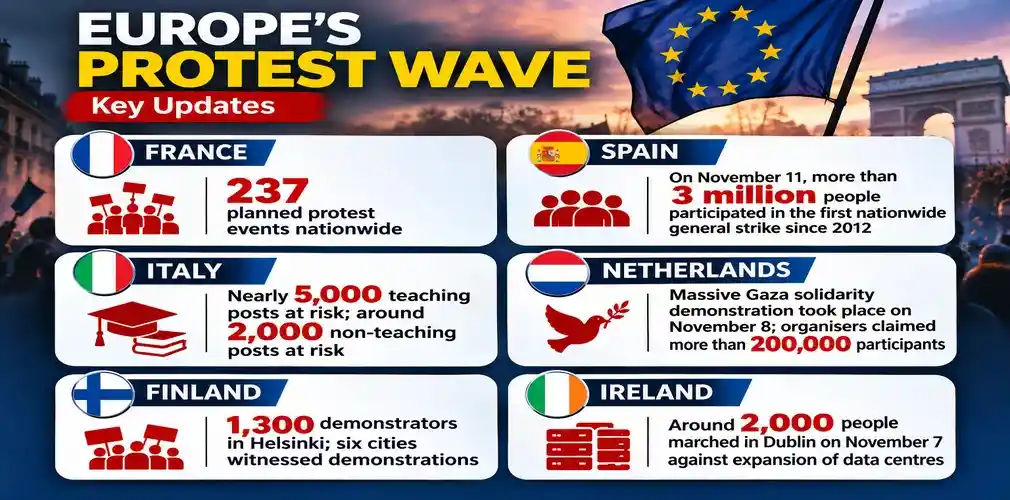
It would be a mistake to view these demonstrations as a single movement with a central command. French high-school students acted as a catalyst, giving expression to shared concerns, and the protests subsequently spread to Belgium, Germany, Italy, Portugal and Spain. The triggers differ from country to country: in Albania, the state of universities; in Germany, the prospect of compulsory military service; and in Spain and Portugal, the cost of housing.
Underneath, however, the common denominators remain the same: soaring housing costs, low wages, the climate crisis and the fear that the social safety net that supported their parents will not be available to their children. All this is unfolding against a backdrop of ageing populations and strained public finances.
The international picture also weighs heavily. Europe is experiencing a period of strategic instability. The United States is no longer seen as an unquestioned guarantor of its security, prompting governments to increase defence spending. China, meanwhile, is an economic and industrial competitor putting pressure on manufacturing, energy and jobs. Caught between these two powers, Europe is struggling to chart a course of its own. As governments seek to rearm and protect their economies in an uncertain international environment, funding for schools, housing and healthcare appears to be slipping down the priority list. Young people see this as a bill they will ultimately have to pay.
There is another troubling reality: governments across the political spectrum, from the right in Italy and the left in Spain to the centre in France, are struggling to offer young people a credible response. This is not a protest against any one political camp, but against an entire political class. It comes ahead of crucial elections in Spain, France, Italy and Greece over the next 12 months.
France: From School to Social Question
After the first high-school strike in September, the movement gathered momentum, culminating on October 17, when tens of thousands of young people filled the streets of Paris to protest against the cost of living. During this period, the Yellow Vests, who had led another revolt against the rising cost of living in 2018–19, joined the students. This coming together of generations changed the nature of the mobilisation, transforming an education dispute into a wider social movement.
The government responded with concessions. According to the SNES teachers’ union, the government dropped its planned job cuts and announced 500 posts to reduce class sizes in some second-year classes, along with 1,264 posts to open classes in BTS vocational courses. Student organisations, however, considered these measures inadequate and objected to the way they were announced. Some education content creators were received at Matignon, the Prime Minister’s Office, ahead of student representatives and were the first to disclose the measures. It is a detail that says much about the relationship between a generation raised on social media and a government that seeks to speak its language without listening to its representatives.
The gap between the ministry’s figures and those of the unions is enormous. On Monday, November 2, as pupils returned from the All Saints’ break, the ministry counted 41 blockaded schools, representing 1 per cent of the country’s roughly 3,700 schools. The Union syndicale lycéenne claimed a much higher figure. The following day, during the so-called ‘black day’ of blockades, the union reported more than 500 high schools fully or partially blocked, against the ministry’s figure of 48. It also reported disruption at 51 of 184 universities. On 5 November, the day of the cross-sector strike, the pattern was repeated: the ministry reported 81 blockaded schools, while the USL claimed that more than 1,000 had been ‘shut down’. On the same day, SNES announced that 52 per cent of staff in middle and high schools were on strike; the ministry put the figure at 13.5 per cent.
The fact that the government has been forced to negotiate, and that school budgets have entered the debate on Prime Minister Sébastien Lecornu’s budget, suggests that the pressure has had an impact. The challenge now is to oppose an austerity budget that the left and trade unions describe as involving cuts worth tens of billions to public services.
Italy: The Wave That Arrived ‘By Contagion’
In Italy, the protest movement drew inspiration from developments across the Alps. “Let’s do like France” became its rallying cry. The initial weeks were marked by tents, occupations and student encampments in schools, fuelled by the movements in neighbouring France and Spain. Then, on October 30, came the national mobilisation.
Dozens of cities hosted marches, including Bologna, Genoa, Naples and Turin, where initial skirmishes broke out with riot police. In Rome, thousands set off from Termini station, accompanied by two tractors and a taxi, before marching past the Colosseum amid flags, banners and megaphones. A heavy security presence was deployed throughout the day, which, on the whole, passed without serious incident.
Behind the numbers are individual stories. Beatrice Chilelli, 21, a university student from Rome, told AFP that students were at breaking point: tuition fees and rent were placing a heavy burden on families, with single rooms in Rome costing up to €1,200 a month. Laura Teresi, 18, spokesperson for the OSA movement, had announced that students would take to the streets to protest against the Meloni government’s rearmament policies and the high cost of living. Among the placards, one message received widespread attention in the international press: more homes, fewer bombs.
The picture is more complex than a straightforward confrontation. The students’ demands were joined by those of lorry drivers and farmers, who were striking over the price of diesel. In Puglia, students, hauliers and farmers marched together in an unprecedented alliance, demonstrating how energy costs have become a common concern across generations and occupations.
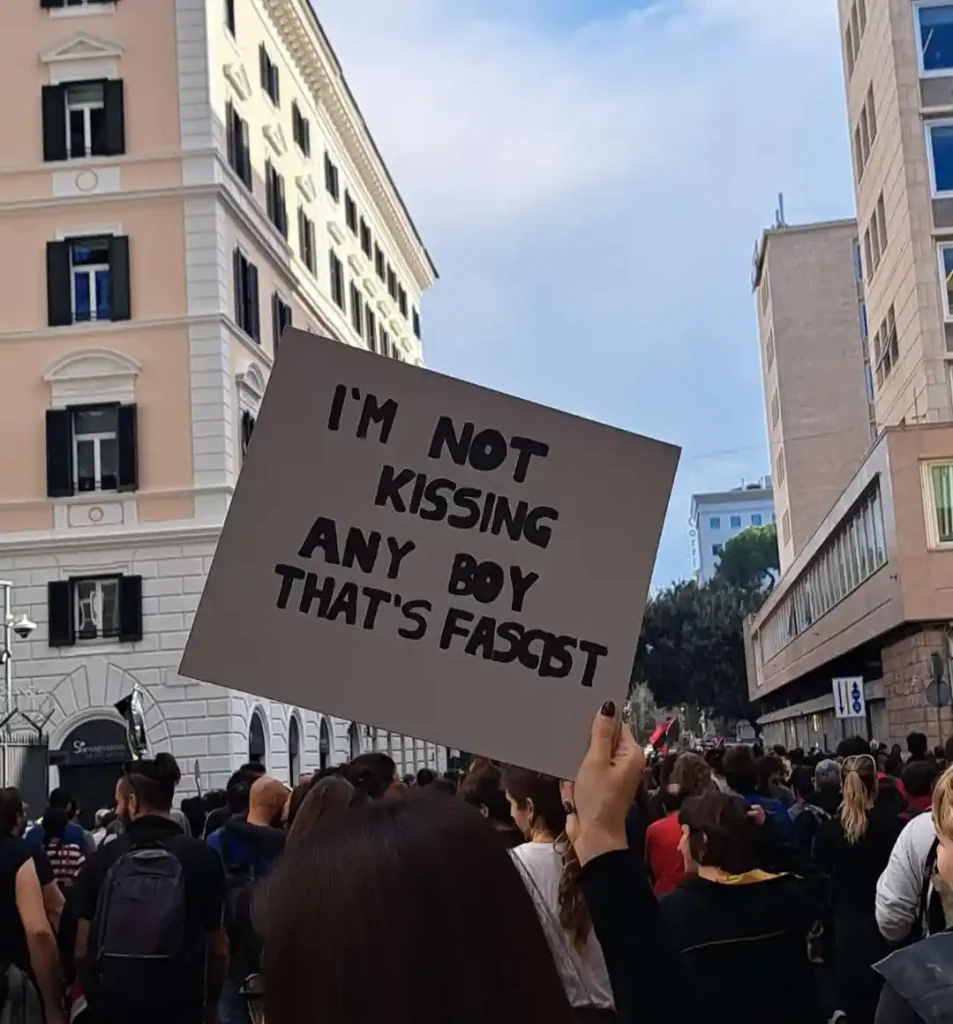
The government has adopted a two-pronged approach. On the one hand, it has taken a hard line: following the disorder in Milan on October 17–18, when young people clashed with police, the government tightened the rules governing demonstrations and relaxed those relating to the detention of minors. Protesters see this as evidence of an increasingly authoritarian policing climate, a phrase that frequently appears in organisers’ statements. On the other hand, the government has offered some concessions: the draft 2027 budget includes measures for young people and families, including an annual bonus of €2,500 for workers under 30. Prime Minister Giorgia Meloni said she hoped to offer answers to young people who felt the state was distant, adding that the measures were not intended for those who smash shop windows.
This is where the battle is being fought. On one side are those who see these young people as an abandoned generation; on the other are those who fear that the streets will be held hostage by violent elements. The government, meanwhile, insists on distinguishing between legitimate protest and public disorder. Both perspectives contain elements of truth, and the task of journalists is to examine them together.
Spain: The Time of the Strike
While marches have dominated the protests in Italy, strikes have taken centre stage in Spain. In Madrid, non-university teachers have been on an indefinite strike for weeks, with demonstrations bringing together hundreds of teachers and students amid tensions and police intervention. Among the most widely discussed incidents were police charges against students during an information picket at the Complutense University. The protests paused as the country went into mourning following the rail accident at Urda, in the province of Toledo, before resuming.
On November 4 and 5, teachers, researchers, administrative staff and students at Madrid’s six public universities went on a two-day strike. Pickets were organised at faculties, followed by a concluding demonstration in the city centre. Organisers hit back at the regional education councillor, who had accused some student groups of wanting to ‘burn the streets’. They viewed the remark as an attempt to undermine the legitimacy of student protests.
On November 11, Spain was gripped by a general strike, joined by education workers in several regions. In Andalusia, the USTEA union called an education strike to coincide with the general strike, while unions in Castilla y León called for a strong blockade. The Sindicato de Estudiantes urged young people to take to the streets and shut down schools and university faculties. Housing remains a particularly pressing issue here. Academics have described a ‘contagion effect’, fuelled by images of the French protests and the tent camps in Portugal.
Protesters have also accused a left-wing government of privatising education and healthcare while approving the largest military budgets in the country’s history. It is further evidence that discontent does not recognise political boundaries.
Germany: ‘Today the Medical, Tomorrow the Draft’
In Germany, the trigger is different, and darker. The movement “Schulstreik gegen Wehrpflicht”, or school strike against compulsory military service, has reached its fifth national day, scheduled for November 20. Students are protesting against the gradual reintroduction of military service. Conscription has not yet been reinstated, but fitness assessments are already underway in at least North Rhine-Westphalia, Bavaria, Hamburg and Schleswig-Holstein.
The political calendar explains the urgency. Following the suspension of conscription in 2011, from July 2027 young men born in 2008 or later will be required to undergo a compulsory medical examination, while women will be able to enlist voluntarily. One of the organisers’ slogans captures the fear: ‘Today the medical, tomorrow the draft.’ In Berlin, students blockaded the entrances to a high school in Friedrichshain, demanding better study conditions, opposing preparations for compulsory military service and expressing solidarity with their French counterparts.
As elsewhere in Europe, the message links military spending with public budgets. Parliament is due to approve the budget in November, and the strikers are demanding more money for education instead of rearmament. According to estimates published by some outlets on the activist left, the October 31 mobilisations drew nearly 200,000 people across more than 30 cities. This figure should be treated with caution. Earlier, tens of thousands had already taken to the streets under the banner “Gen Z regelt”. In a country where school attendance is compulsory by law and taking part in a strike carries consequences, the gesture assumes particular significance.
Albania: The Harshest Square
Perhaps the most bitter confrontation has unfolded in Albania. On October 13, a student march gathered outside the Ministry of Education in Tirana, where protesters threw stones at the building and police. In the following days, clashes escalated, culminating in an attack on the city hall, which was set on fire. Protests also spread to Shkodër, Vlorë, Elbasan, Durrës and Korçë.
The backdrop is the so-called “Flamingo Revolution”, which began in the spring as a protest against a luxury resort on a protected coastline and subsequently widened to encompass corruption and the state of universities. Analysts describe it as a horizontal rebellion, organised through social media and without a single central structure, bringing together secondary-school and university students, environmentalists and frustrated citizens. Their stated grievances include corruption, nepotism and a lack of opportunities.
Prime Minister Edi Rama ruled out resigning and blamed the escalation on ‘foreign hands’ that did not want peace in Albania. Protesters rejected this interpretation. Equally striking was their refusal to be co-opted by the opposition. Democratic Party MPs who attempted to join the marches were told to leave, while slogans targeting both historic political leaders were heard in the squares. For these young people, the problem is the system, not one political camp.
An Albanian political scientist pointed out that social change was more likely to emerge from broad coalitions than from student mobilisation alone. Albania is a candidate for European Union membership, but wages, purchasing power and public services remain well below the European average, a gap that weighs heavily on those in their twenties.
Other Squares, One Question
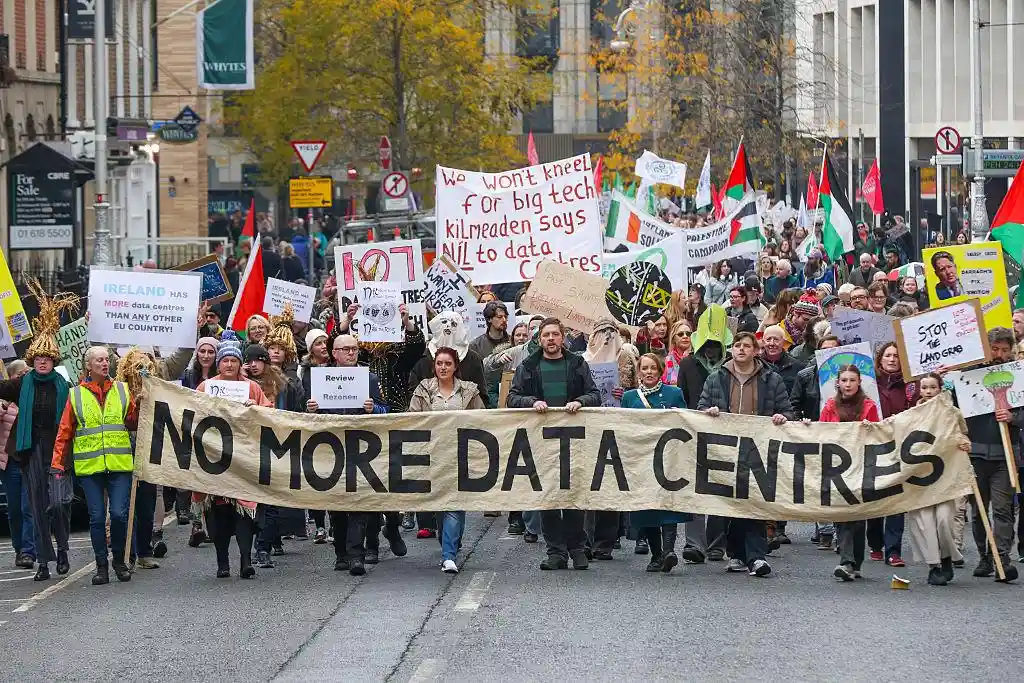
The protests extend well beyond these five countries. In Greece, students took to Syntagma Square in Athens on October 13 to protest against the cost of university accommodation. In Portugal, where the housing crisis is among the most severe in Europe, tens of thousands marched against soaring rents, and the tent camps were subsequently dismantled. In Ireland, more than 1,500 students marched in Dublin against rising costs and fees. Significant demonstrations were also reported in Belgium, the Czech Republic and Serbia, alongside strikes and smaller protests in several other countries across the continent.
Politicians are watching with apprehension, and not merely because of the shattered glass. Reports suggest that the disorder has allowed the radical right to push its law-and-order agenda. It is the paradox of every youth-led protest movement: anger demands a stronger welfare state but risks strengthening those who promise a more powerful police state. That is why the protests need to remain anchored in their concrete demands, while those in power must listen before the unrest escalates further.
The calendar suggests that the story is far from over. A European student strike is planned for November 20, with young people from France, Germany, Italy, Greece, Great Britain and Spain expected to participate. The mobilisation aims to defend public education against policies that organisers describe as privatisation, as well as oppose militarism. On the same day, Germany will witness the fifth national day of protests against compulsory military service.
What Will Remain
No one can say. Public squares empty quickly when the cold sets in and examinations approach. But there is something that neither government nor union figures can measure: a generation that has decided to make its voice heard. These young people are between 15 and 25. They can organise overnight using a mobile phone, and they no longer believe the promise that today’s sacrifices will guarantee tomorrow’s prosperity. All they ask of governments, whether on the left or the right, is to make that promise a reality.
The future cannot be handed back through a bonus or a government circular. It must be built through open schools, affordable homes, decent wages and a foreign policy that does not ask the young to pay the price of wars waged by adults.