There is something deeply human about the meeting of faith and apprehension. What makes a woman go without food and water for more than thirty-six hours, stand waist-deep in a river at sunset, and return before dawn to do it all over again? What gives her the strength to endure such hardship year after year? And why can a missing offering or a small mistake in the ritual cause her such deep anxiety?
To someone watching from the riverbank, Chhath may appear to be a beautiful festival of offerings to the Sun. But for the women who undertake its demanding fast, it is often something far more personal. It is a promise made in faith, a prayer for the family and, sometimes, a solemn responsibility accompanied by the fear of what might happen if that promise is not fulfilled.
Chhath is observed twice a year, as Kartika Chhath and Chaiti Chhath, though the Kartika festival is more widely celebrated. Its four days begin with Nahay Khay, when homes and kitchens are cleaned and the person undertaking the fast, known as the vrati, takes a simple meal.
The following day is Kharna. After fasting through the day, the vrati performs the evening puja and prepares the prasad, often including kheer and roti. The food is shared with family and others. Thereafter begins the demanding nirjala vrat, a fast without food or water that continues until the morning offering to the rising Sun, encompassing both the evening offering to the setting Sun and the night in between.
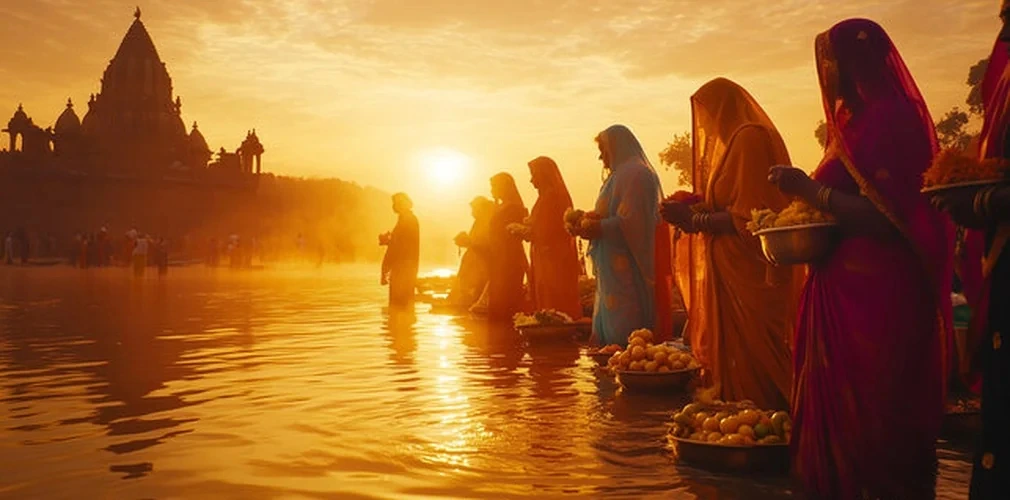
The two offerings, Sandhya Arghya and Usha Arghya, are the heart of the festival. At sunset, devotees enter the water and offer prayers to the departing Sun. Before dawn, they return to welcome the rising Sun. Bamboo baskets and soops carry seasonal fruits, sugarcane, thekua and other offerings. Lamps flicker, folk songs rise above the water, and families gather along the riverbank. Yet, amid all this activity, the vrati remains absorbed in her prayers.
For many, Chhath is undertaken as a manauti, a vow made in the hope of divine help. The prayer may be for a child’s health, the well-being of the family, a marriage, employment or relief from a difficult situation. Sometimes the vow follows a long period of uncertainty, when every available remedy seems to have been exhausted. A mother prays for her child. A family seeks relief from a crisis. A woman promises to undertake the fast if her wish is fulfilled. And when it is, she returns to honour that promise.
This is where the strength of belief reveals its more vulnerable side. A missing item, an imperfect offering or a mistake in the ritual can cause genuine distress. The woman may worry that she has done something wrong, that she has not completed her vow properly, or that some misfortune might befall her family because of it. Her concern is not necessarily about what other people might think. It is about the unseen consequence she fears.
The same woman who believes that her prayers can protect her family may be frightened of making the smallest mistake. Every preparation matters, every offering has its place, and the vow must be completed with care. The burden is physical, but it is also emotional. For the vrati, the well-being of those she loves may seem bound to the promise she has made.
And yet, the faith expressed through Chhath is rarely complicated. The prayers are often straightforward: let the child be well, let the family remain safe, let a difficult time pass. The women prepare the offerings, keep the fast, sing the traditional songs and carry out every part of the ritual with great care. Their faith does not depend upon elaborate explanations. It lives in the act itself.
The songs of Chhath bring this world alive. Passed down through generations, these Bhojpuri, Maithili and Magahi folk songs accompany almost every stage of the festival. One familiar refrain, “Kaanch hi baans ke bahangiya, bahangi lachkat jaaye”, evokes the slender bamboo carrying pole swaying under the weight of the offerings as it makes its way to the river. It is a song of movement and devotion, often heard as families carry their baskets towards the ghat.
Then comes the wait for dawn. As the darkness begins to lift, another familiar call rises from the riverbank: “Ug he Suraj Dev, bhel bhinsarwa” (Rise, O Sun, dawn has arrived). The words are simple, almost like a gentle summons. But after a night of fasting, prayer and waiting, they carry a special feeling. The first rays of sunlight touch the water, the offerings are made, and the long wait finally comes to an end.
The goddess invoked in these songs is Chhathi Maiya, widely associated with Shashthi Mata, a protective mother figure connected with children. Traditions about her identity vary, but for devotees she is an intimate presence, one to whom a mother can entrust the well-being of her children. She is invoked alongside Surya, the Sun, whose setting and rising mark the two great moments of the festival.
There are other distinctive customs too. In some communities, Kosi Bharna involves creating a small canopy with sugarcane stalks, placing offerings beneath it and lighting lamps. The sight of the lamps glowing beneath the sugarcane is among the festival’s most memorable scenes.
Strongly associated with Bihar, Chhath is also celebrated in Jharkhand, eastern Uttar Pradesh, parts of Bengal and Nepal. Migration has carried it far beyond these regions. For families living away from their ancestral homes, the festival becomes a way of returning, even if only in memory, to the courtyards, riverbanks and songs of childhood.
Relatives come together, offerings are shared and the prasad travels from one home to another. For younger generations growing up in cities, it can also be a connection to a cultural world their parents and grandparents have carried with them.
Perhaps Chhath’s deepest mystery lies in the faith that sustains it. The fast demands physical endurance, but the vow demands something more difficult: an unwavering trust in a power that cannot be seen or measured. To dismiss this as mere superstition would be to overlook the feelings and beliefs through which the festival has survived for generations. To explain it simply as gratitude to the Sun would be equally inadequate.
What sustains such faith? Is it the memory of prayers answered, the hope of protecting one’s children, the fear of an unfulfilled promise, or the conviction that Chhathi Maiya listens? Perhaps it is all of these.
And perhaps that is why, as the songs rise over the river and the first light touches the water, Chhath remains not simply a festival of worship, but one of the most moving expressions of faith in everyday Indian life.